

A great haircut looks effortless, but behind every clean fade and sharp line sits a quiet negotiation between three forces: the symmetry your eye wants to see, the hairline nature gave you, and the direction your hair naturally wants to grow. Master barbers spend years learning to read these signals before the clippers ever touch skin. This guide breaks down exactly how that balancing act works, why no two heads are cut the same way even with the same style request, and what you can do to get a haircut that holds up between visits. Whether you’re booking your first proper cut, getting your son ready for picture day, or gifting a grooming session to someone who’s been overdue for one, understanding this process will change how you talk to your barber.
Key Takeaways
- Perfect facial symmetry is rare, so barbers cut for balance, not mathematical perfection, adjusting part lines, fades, and length to make asymmetry less noticeable.
- Your hairline shape (straight, widow’s peak, uneven, receding) dictates where a barber can safely create sharp lines versus where they need to soften the edge.
- Natural growth patterns, like cowlicks and whorls, often override what a client requests, because cutting against the grain creates styling problems that no product can fully fix.
- A skilled barber reads all three factors together in under two minutes, which is why consultation time matters more than the brand of clippers in the drawer.
- Haircuts that respect your natural growth and hairline age better between appointments, saving you money and frustration over a 6 to 8 week cycle.
The First Thirty Seconds: What a Barber Actually Sees When You Sit Down
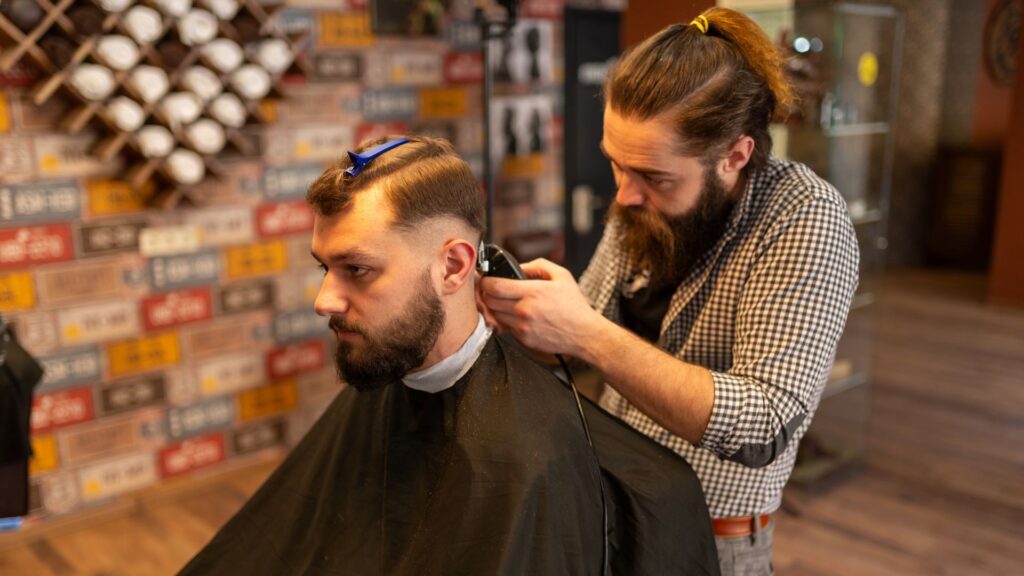
Before a single clipper guard touches your head, an experienced barber is already working. The first thirty seconds in the chair are a visual audit, not small talk filler. Your barber is scanning your hairline, checking how your ears sit relative to each other, noting whether your crown sits high or low, and watching how your hair falls when it’s dry versus damp.
Why the Consultation Matters More Than the Clipper Guard Number
A number 2 on one head looks completely different from a number 2 on another, because the starting canvas is never identical. During consultation, a barber is quietly answering several questions: Does this client’s hairline recede more on one side? Is there a cowlick near the crown that will fight against a side part? Does one ear sit slightly higher, which will throw off a symmetrical fade line if ignored? According to a 2022 survey by Barbicide, over 60% of client dissatisfaction with haircuts traces back to poor or rushed consultations rather than poor execution with the clippers. That statistic alone explains why the best barbershops build in real time for this step instead of rushing straight to the cut.
Reading Dry Hair Before It Gets Wet
Most barbershop visits start with dry hair inspection, and there’s a reason for that sequence. Wet hair clings flat and hides natural growth patterns, cowlicks, and the true density of your hairline. A barber who wets your hair first, before checking how it falls naturally, is skipping a diagnostic step that determines everything that follows. Dry hair reveals the “default setting” your hair returns to after a shower, a swim, or a long day, which is the version of your head your barber actually needs to design around.
The Three-Point Facial Check
Many professional barbers use what’s informally called a three-point check: comparing the hairline, the ears, and the jawline against an imaginary centerline running down your face. This isn’t about shaming asymmetry, because every face has some. It’s about identifying where the eye naturally lands and adjusting the haircut so the final result reads as balanced, even if the underlying bone structure isn’t perfectly even.
This initial read sets the foundation for everything that comes next, which is why understanding facial symmetry itself is the natural next stop.
What Does “Symmetry” Actually Mean in a Haircut?
Symmetry in barbering doesn’t mean a mirror image down the middle of your face. True facial symmetry barely exists in real human faces, with research from facial recognition studies suggesting less than 10% of people have faces that are symmetrical within a few millimeters on each side. Barbers work with this reality instead of fighting it.
Perceived Symmetry vs. Measured Symmetry
There’s a difference between what a ruler says and what an eye perceives. A face can be measurably uneven, with one eye socket sitting slightly lower or one side of the jaw wider, and still appear symmetrical to a casual observer because the brain fills in gaps and rounds things off. Barbers aim for perceived symmetry, which means adjusting hair length, part placement, or fade height so the final look reads as even, even when the underlying anatomy isn’t.
How Barbers Use Length to Create Balance
If one side of your face is fuller or your jaw is wider on one side, a barber might leave slightly more length on the opposite side to visually “pull” the eye toward center. This is the same principle a tailor uses when cutting a jacket to flatter an uneven shoulder line. Hair is fabric that moves and falls, and a trained barber uses it the same way a stylist uses drape and cut to balance a silhouette.
The Role of Parting and Fade Height in Correcting Imbalance
Where a part sits, and how high a fade climbs on each side, are two of the most powerful tools a barber has for correcting visual imbalance. A part shifted slightly off a client’s natural midline can offset an uneven hairline. A fade that climbs half a guard higher on one side than the other, done intentionally rather than sloppily, can correct for an ear that sits higher or a temple that recedes more aggressively.
| Visual Imbalance | Common Barber Correction |
| One ear higher than the other | Fade line adjusted slightly to even perceived symmetry |
| Uneven jawline width | Added length on fuller side, shorter on narrower side |
| Asymmetrical hairline recession | Part line shifted away from the more recessed side |
| One eyebrow higher | Fringe or fade height matched to softer brow for balance |
| Wider forehead on one side | Side-swept fringe to minimize width perception |
Understanding how symmetry gets corrected naturally leads to the next challenge: the hairline itself, which doesn’t always cooperate with what a client has in mind.
Why Your Hairline Shape Changes What a Barber Can Actually Do
No two hairlines are the same, and your hairline shape is one of the biggest limiting factors in what style will actually work. A barber cannot cut a style onto a hairline that physically contradicts it, no matter how detailed the reference photo is.
The Five Common Hairline Shapes
Dermatologists and barbers generally group hairlines into five rough categories: straight across, widow’s peak, uneven or zigzag, receding at the temples, and high/rounded. Each shape interacts differently with hard parts, fades, and fringe styles.
| Hairline Shape | Best Suited Styles | Styles to Avoid |
| Straight across | Hard parts, crew cuts, textured crops | Overly slicked styles that expose flatness |
| Widow’s peak | Quiffs, side parts that work with the peak | Center parts that fight the peak |
| Uneven/zigzag | Textured fringe, disconnected undercuts | Precise hard parts that highlight unevenness |
| Receding temples | Buzz cuts, crew cuts, low fades | Long fringe that draws attention to recession |
| High/rounded | Fringe-forward styles, fuller top | Very short all-over cuts that expose forehead height |
Why a Hard Part Isn’t Right for Every Hairline
Hard parts, the shaved line separating a side part from a fade, are visually striking, but they require a relatively clean, cooperative hairline to look intentional rather than messy. If your hairline zigzags or recedes unevenly, a hard part can actually emphasize the irregularity rather than hide it. Experienced barbers will often talk clients out of a hard part request if the hairline underneath won’t support it cleanly, even if the client has a photo from a magazine or social media.
Working With a Receding Hairline Instead of Fighting It
A receding hairline doesn’t mean limited options. It means different options. Buzz cuts, crew cuts, and low fades reduce the contrast between hairline and scalp, which minimizes how much the recession stands out. According to the American Hair Loss Association, approximately two-thirds of American men experience some degree of hair loss by age 35, which means this is a scenario the average barbershop handles daily, not an exception.
Hairline Maintenance Between Visits
A sharp hairline edge-up fades within days as new growth comes in, which is why many men schedule a lineup every 1 to 2 weeks between full haircuts. This is especially common for clients who keep their hair short and want that crisp edge maintained continuously, rather than letting it grow soft and blurry between full cuts.
Once the hairline shape is accounted for, the next variable barbers factor in is something most clients have never consciously noticed about their own head: natural growth patterns.
How Natural Growth Patterns Override Style Requests
Every head of hair has a direction it wants to grow, and fighting that direction is one of the fastest ways to end up with a haircut that looks great in the chair and falls apart an hour after you leave. Natural growth pattern is the single most underestimated factor in a successful haircut.

What Are Cowlicks, Whorls, and Growth Patterns?
A cowlick is a spot where hair grows in a circular or spiral direction instead of lying flat, most commonly at the crown. A whorl is essentially the technical term for this spiral pattern, and nearly everyone has at least one, with the crown whorl being almost universal. Growth patterns also exist along the hairline and nape, where hair can grow forward, backward, or at odd angles that affect how a fade blends or how a fringe falls.
Why You Can’t Cut Against a Strong Growth Pattern
Hair that’s cut against its natural growth direction tends to stand up, stick out, or refuse to lie flat no matter how much product is applied. A barber who ignores a strong cowlick and cuts a style that requires the hair to lie flat over it is setting the client up for daily frustration. This is similar to how a carpenter works with the grain of wood rather than against it; cutting against the grain makes everything downstream harder, from sanding to finishing.
Common Growth Pattern Challenges and Barber Solutions
| Growth Pattern Challenge | Barber Solution |
| Crown cowlick | Leave slightly more length at crown, cut shorter length into cowlick direction |
| Double crown whorl | Avoid very short buzz cuts, keep some length for weight and control |
| Nape hair growing upward | Taper nape gradually rather than cutting a hard line |
| Front hairline cowlick | Style fringe to work with the swirl rather than against it |
| Sideburn hair growing forward | Trim at an angle matching growth rather than a straight vertical line |
How Hair Texture Interacts With Growth Patterns
Straight hair tends to show growth pattern issues more visibly, because there’s no natural curl pattern to disguise an awkward cowlick. Curly and coily hair can sometimes mask growth pattern quirks better, but it introduces its own complexity around shrinkage and how length looks different wet versus dry. A barber adjusts their cutting angle, the guard length, and sometimes the entire recommended style based on texture combined with growth direction, not texture alone.
This is why two clients requesting the exact same photo reference can walk out with noticeably different results. It’s not a failure of skill. It’s a correct response to two different heads.
Symmetry vs. Hairline vs. Growth Pattern: Which Factor Wins When They Conflict?
Sometimes these three forces pull in different directions, and a barber has to decide which one takes priority. When symmetry, hairline shape, and growth pattern conflict, growth pattern almost always wins, because fighting it produces a haircut that physically won’t behave, regardless of how good it looks immediately after cutting.
Scenario One: Symmetrical Request vs. Uneven Hairline
A client asks for a perfectly symmetrical fade on both sides, but their hairline recedes more on the left. A barber who forces identical fade heights on both sides will end up with a cut that looks lopsided because the hairline itself is uneven, even though the fade measurements are technically equal. The correct move is adjusting fade height slightly to compensate for the hairline, prioritizing perceived symmetry over measured symmetry.
Scenario Two: Hairline-Friendly Style vs. Strong Cowlick
A widow’s peak might suggest a quiff would look sharp, but if there’s a strong cowlick right at the peak, the quiff may refuse to sit the way it does in a reference photo. In this case, a skilled barber will usually recommend a slight modification, perhaps a side-swept variation that works with the cowlick’s spiral rather than against it.
Scenario Three: Client’s Reference Photo vs. All Three Factors
This is the most common real-world conflict. A client arrives with a photo of a celebrity or influencer haircut, and that model’s hairline, symmetry, and growth pattern are completely different from the client’s own. A good barber doesn’t simply replicate the photo. They extract the style elements the client likes, the general shape, the fade style, the length on top, and reinterpret them to fit the client’s actual head.
Decision Framework Barbers Use
| Conflict Type | Priority Order |
| Symmetry request vs. hairline shape | Hairline shape wins, symmetry adjusted around it |
| Hairline-friendly style vs. growth pattern | Growth pattern wins, style modified to work with it |
| Reference photo vs. client’s actual features | Client’s features win, photo used as inspiration only |
| Low maintenance request vs. ideal style for features | Low maintenance wins if client is clear about effort level |
Understanding this hierarchy helps explain why your barber might gently push back on a specific request, and why that pushback usually leads to a better outcome than a literal copy of a photo.
Common Mistakes Clients and Barbers Make With Symmetry, Hairlines, and Growth
Even experienced professionals can slip up, and clients often unknowingly set themselves up for a disappointing result. Most haircut regret traces back to one of a handful of predictable mistakes, nearly all of which are avoidable with better communication.
Mistake One: Bringing a Reference Photo Without Context
Showing a photo is useful, but showing a photo without explaining what specifically you like about it (the length, the fade, the texture) leaves the barber guessing. A barber working blind might focus on the wrong details, replicating a hairline shape that doesn’t exist on your head instead of the texture or fade style you actually wanted.
Mistake Two: Ignoring Growth Pattern Feedback
When a barber mentions a cowlick or growth pattern concern, some clients dismiss it as an excuse rather than useful information. Ignoring this feedback and insisting on a style that fights the grain almost guarantees a haircut that won’t style properly at home, even with the right products.
Mistake Three: Forcing Symmetry That Doesn’t Suit the Face
Some clients specifically request perfectly even fades or symmetrical parts without realizing their face has natural asymmetry that this will actually highlight rather than hide. A barber’s job here is part technical skill, part gentle education, explaining why a slight adjustment will look more balanced than a mathematically identical cut.
Mistake Four: Rushing the Consultation
Clients in a hurry sometimes skip the consultation conversation entirely, sitting down and saying “just do a fade” or “same as last time” without acknowledging that hair changes over months, seasons, and even stress levels. This leaves the barber working with incomplete information, increasing the odds of a result that doesn’t match expectations.
Mistake Five: Not Communicating Lifestyle and Maintenance Reality
A style that requires daily blow-drying and product application isn’t realistic for someone who showers and leaves in five minutes each morning. Barbers need this information to recommend a cut that actually fits how you’ll maintain it, not just how it looks the moment you leave the chair.
| Mistake | Better Approach |
| Vague photo reference | Explain specific elements liked (length, fade, texture) |
| Dismissing growth pattern advice | Trust barber feedback on cowlicks and whorls |
| Demanding perfect symmetry | Ask what will look most balanced for your face |
| Rushing consultation | Allow 2 to 5 minutes for proper discussion |
| Hiding maintenance habits | Be honest about daily styling time and effort |
Avoiding these mistakes sets up a much smoother conversation at your next appointment, which naturally leads into how real clients navigate these exact issues in practice.
Real-World Scenarios: How This Plays Out in the Barber Chair
Theory is useful, but seeing how symmetry, hairline, and growth pattern considerations play out with actual clients makes the concept concrete.

Scenario: The Dad Booking a Haircut for His Son
A father brings his 10-year-old son in for a Haircut before school pictures, requesting a sharp side part like his own. The barber notices the boy has a strong cowlick right where the part would need to sit flat. Instead of forcing the part, the barber suggests a textured crop with a soft side-swept fringe, explaining to the dad that it will look just as sharp in photos without fighting the cowlick for the rest of the week. The dad leaves understanding why the adjustment happened, and the boy’s hair actually stays neat through recess and gym class.
Scenario: The Groomsman With an Uneven Hairline
A client getting ready for a wedding wants a clean, symmetrical fade for photos, but one side of his hairline sits noticeably higher than the other, a feature he’d never consciously noticed. The barber adjusts the fade height slightly higher on the lower side, creating a visual balance that reads as symmetrical in every wedding photo, even though the actual fade lines aren’t identical in measurement.
Scenario: The Gift Certificate Client Who’s Never Had a Proper Cut
Someone receives a gift card to a barbershop near me search result and books an appointment, having only ever used home clippers or a quick trim at a chain salon. The barber spends extra time on consultation, discovering a receding hairline the client has been self-conscious about and a crown whorl he never noticed. The result is a buzz cut with subtle tapering that minimizes the recession and works with, rather than against, the crown pattern, giving the client his first haircut that actually looks intentional.
Scenario: The Client Chasing an Influencer’s Style
A client in his twenties brings a screenshot of an influencer’s slicked-back undercut, but his hairline shape is a zigzag pattern that won’t hold a clean slick-back without visible gaps. The barber explains the limitation honestly, offers a textured version with slightly more length to disguise the irregularity, and the client ends up preferring the modified version because it actually looks neat all day instead of gapping by noon.
These scenarios repeat daily in barbershops everywhere, which is exactly why experience matters as much as technical skill.
How Much Does This Level of Precision Cost, and Is It Worth It?
Precision cutting that accounts for symmetry, hairline, and growth pattern typically costs more than a basic trim, but the value shows up in how much longer the cut holds its shape.
Typical Price Ranges by Service Level
| Service Level | Typical Price Range (USD) | What’s Included |
| Basic clipper cut | $15 to $25 | Single guard length, minimal consultation |
| Standard barbershop haircut | $25 to $45 | Consultation, scissor and clipper work, basic styling |
| Premium precision cut | $45 to $75 | Extended consultation, symmetry correction, growth pattern analysis |
| Full grooming package | $60 to $120 | Precision cut, hot towel, beard trim, styling product application |
Why Paying More Often Saves Money Over Time
A precision cut that accounts for your hairline and growth pattern typically holds its shape for a full 4 to 6 week cycle, while a rushed basic cut can start looking messy within 2 to 3 weeks as uncorrected growth patterns reassert themselves. Over a year, fewer, higher-quality visits can cost about the same as more frequent cheap trims, while looking sharp for a larger percentage of the time between appointments.
Is It Worth It for Occasional Clients?
For someone who only gets a Haircut a few times a year, investing in a barber who takes the extra consultation time matters even more, because there’s less margin for a bad cut to grow out quickly before the next big event. For regular clients visiting every few weeks, the cost difference evens out over a year while still delivering a consistently better-looking result.
Cost and value naturally lead into what’s actually changing in the industry around these techniques, which is where trends and expert insight come in.
What Barbers and Industry Experts Are Saying About Modern Precision Cutting
The barbering industry has shifted noticeably toward precision and consultation-driven service over the last decade, moving away from the one-size-fits-all approach common in older barbershop models.
The Rise of Consultation-First Barbershops
Many modern barbershop chains and independent shops now build consultation time directly into their booking structure, treating it as a billable, valued part of the service rather than small talk before the real work begins. Industry trade publications like American Salon have reported growing emphasis on “diagnostic cutting,” where barbers are trained specifically to assess hairline, growth pattern, and facial structure before touching clippers.
Education Standards Are Catching Up
Barber schools increasingly include dedicated coursework on facial symmetry analysis and hair growth pattern recognition, topics that were historically picked up informally through years of apprenticeship rather than taught directly. This formalization means newer barbers are entering the industry with faster access to skills that previously took a decade of trial and error to develop.
Social Media’s Double-Edged Influence
Platforms like Instagram and TikTok have pushed client expectations higher, with more people arriving with specific reference photos than ever before. This has pressured barbers to get better and faster at explaining why a direct copy isn’t always possible, turning consultation skills into as much of a differentiator as technical cutting ability.
What Experienced Barbers Say Sets Great Cuts Apart
Veteran barbers consistently point to the same theme: technical skill with clippers and scissors is table stakes, but the ability to read a head accurately in the first few minutes is what separates a good haircut from a forgettable one. That skill comes from thousands of repetitions, not from any single technique or tool.
These industry shifts set the stage for a practical question most clients actually want answered: how do you apply all of this the next time you book an appointment?
Your Action Plan: What to Do Before and During Your Next Haircut
Knowing the theory is one thing. Putting it into practice at your next appointment is what actually improves your results.
Before Your Appointment
- Take note of how your hair naturally falls after a shower, before any product or styling, and be ready to describe it.
- Identify any spots where your hair seems to “fight” a style, especially near the crown or hairline.
- Gather reference photos, but be ready to explain the specific elements you like rather than expecting an exact copy.
- Think honestly about how much time you’ll spend styling daily, and be upfront about that during consultation.
During the Consultation
- Let your barber examine your hair dry before it gets wet, and don’t rush this step.
- Ask directly: “Do I have any cowlicks or growth patterns I should know about?”
- If your barber suggests a modification to your requested style, ask why, rather than assuming it’s a limitation of skill.
- Mention any past haircuts that didn’t hold up well, and describe exactly how they failed (grew out oddly, wouldn’t lie flat, looked uneven).
After the Haircut
- Ask your barber to show you how to style the cut at home, specifically around any growth pattern challenges.
- Schedule your next appointment on a realistic cycle (every 2 to 3 weeks for short fades, 6 to 8 weeks for longer styles) rather than waiting until it looks visibly overgrown.
- If something isn’t sitting right within the first week, communicate it at your next visit rather than assuming it will fix itself.
Quick Reference Checklist
| Step | Action |
| 1 | Observe natural dry hair fall before your appointment |
| 2 | Bring reference photos with specific context, not just images |
| 3 | Disclose daily styling time honestly |
| 4 | Ask about cowlicks, whorls, and hairline shape directly |
| 5 | Trust barber adjustments to reference photos |
| 6 | Book follow-up appointments on a realistic cycle |
With a clear action plan in hand, a few lingering questions tend to come up again and again, which is exactly what the next section addresses.
Frequently Asked Questions
Can a barber completely change my hairline shape?
No, a barber cannot physically change the shape of your hairline, since that’s determined by genetics and, in some cases, how hair loss has progressed over time. What a skilled barber can do is design a cut that minimizes the visual impact of an uneven or receding hairline, using techniques like low fades, textured fringes, or adjusted part placement to draw attention away from the areas you’re self-conscious about.
Why does my barber keep mentioning a cowlick I’ve never noticed before?
Cowlicks and whorls are often invisible to the untrained eye because they only become obvious when hair is cut short enough, or styled in a direction that works against the natural growth. Your barber spots these patterns because they’re specifically trained to look for them, and ignoring one almost guarantees a styling headache for you between visits.
Is it possible to have a perfectly symmetrical haircut?
True mathematical symmetry is extremely rare in real faces, so most “symmetrical-looking” haircuts are actually asymmetrical on paper but balanced visually. A good barber adjusts length and fade height unevenly on purpose to create the appearance of symmetry, rather than cutting both sides identically and hoping for the best.
How often should I get a haircut to maintain symmetry and hairline sharpness?
Most men benefit from a full cut every 4 to 6 weeks, with an optional lineup or edge-up every 1 to 2 weeks if they keep a short, sharp hairline style. Longer or textured styles can stretch to 6 to 8 weeks between full cuts, since growing-out length is less noticeable than a fading hairline edge.
What should I do if I have a strong cowlick that ruins every style I want?
Work with your barber to identify a style that uses, rather than fights, the direction of the cowlick, since forcing a flat style over a strong growth pattern rarely works long-term. Slightly longer length at the problem area, textured cuts, or a modified version of your desired style usually solves the issue without sacrificing the overall look you’re going for.
Can hair products fix a bad haircut that ignored my growth pattern?
Products can help temporarily, but they’re treating a symptom rather than the underlying cause. A haircut that genuinely respects your growth pattern will require far less product and effort to look good daily, compared to one that’s constantly fighting your hair’s natural direction.
Why did my haircut look different one week after I got it done?
Hair grows roughly half an inch per month on average, and as it grows out, natural growth patterns and cowlicks that were initially controlled by the fresh cut start to reassert themselves. This is completely normal and is one reason barbers recommend maintenance appointments rather than stretching too long between visits.
Should I always bring a reference photo to my haircut appointment?
Yes, but context matters more than the photo itself. Explain specifically what you like about the reference, whether it’s the fade height, the texture on top, or the overall length, so your barber can adapt those elements to your actual hairline, symmetry, and growth pattern instead of attempting an exact, potentially unworkable copy.
What’s the difference between a barbershop and a regular hair salon for this kind of precision work?
Barbershops traditionally specialize in shorter, precision-focused men’s cuts, including fades, clipper work, and hairline detailing, while many salons are built around a broader range of services with less daily repetition in these specific techniques. This specialization is part of why barbers often develop sharper instincts for reading hairlines and growth patterns quickly.
Your Next Cut Doesn’t Have to Be a Gamble
A great haircut isn’t luck, and it isn’t just about finding someone handy with clippers. It comes down to reading three things accurately: how your face balances visually, how your hairline actually sits, and which direction your hair wants to grow whether you’ve asked it to or not. Once you understand that your barber is quietly solving this puzzle every time you sit in the chair, conversations about your cut become a lot more productive. You’ll know why they might gently push back on a photo, why they spend an extra minute checking your hair dry before wetting it, and why the cut they recommend might differ slightly from what you originally pictured.
Next time you’re due for a trim, come in with a little more awareness: notice your own cowlicks, be honest about your styling habits, and trust the professional who does this hundreds of times a week. The result will be a cut that doesn’t just look good walking out the door, but one that actually holds its shape, flatters your features, and makes your next few weeks easier, not harder.