
Quick answer: Maintaining a stylish beard at home comes down to five habits: washing it two to three times a week with beard-specific products, moisturizing daily with oil or balm, trimming your neckline and cheek line weekly, eating a protein-rich diet that supports hair growth, and scheduling a professional shape-up every four to six weeks. Master these five, and your beard will look barbershop-fresh every single day.
Pull up a chair. Grab a coffee. We’re about to have the kind of conversation men usually only have in a barbershop, the kind where the clippers are buzzing in the background and somebody’s uncle is telling a story that’s probably only 60% true.
A beard is not a hairstyle you can ignore and hope it fixes itself. It’s closer to a garden. Left alone, it grows wild, patchy in some corners, wiry in others, and about as flattering as a hedge that hasn’t been touched since spring. Tended properly, that same beard becomes the single most defining feature on a man’s face, the thing people notice before they notice his shirt, his watch, or his handshake.
This guide is long because the topic deserves it. We’re going to cover the history behind why beards carry weight, the biology of how they grow, the tools you actually need (and the ones you’re wasting money on), the products worth your bathroom counter space, and the exact routines that separate a groomed man from a guy who “has a beard.” We’ll get into face shapes, skin issues, diet, travel, budgets, and what the pros do differently. By the end, you’ll have a complete system, not just a pile of tips.
Let’s get into it.
Why Your Beard Deserves More Attention Than You Think
The Cultural Weight of the Beard Through History
Beards have never been neutral. Ancient Egyptian pharaohs wore false metal beards as a symbol of divine authority, even the female ones. Greek philosophers considered a full beard a mark of wisdom, so much so that Alexander the Great’s decision to keep his soldiers clean-shaven (to prevent enemies from grabbing their beards in combat) was seen as radical. Victorian England went through a beard boom in the mid-1800s, with facial hair signaling masculinity and moral seriousness.
The 20th century swung the pendulum back and forth. Clean-shaven faces dominated corporate America through the 1950s and ’60s. Then came the counterculture beard of the ’70s, the clean-cut ’80s and ’90s, and the full-blown beard renaissance that kicked off around 2010 and hasn’t slowed down since.
What this tells you is simple: the beard has always been a statement. It’s just that today, the statement is personal rather than tribal. Nobody’s judging you for your political affiliation based on your beard length anymore. They’re judging your grooming habits instead, which is arguably a fairer standard.
What a Well-Kept Beard Actually Says About You
A sharp beard reads as discipline. It suggests a man who pays attention to detail, who takes ten extra minutes in the morning because he cares about how he shows up in the world. Recruiters, dates, and even casual acquaintances form snap judgments based on grooming, and a patchy, uneven, or scraggly beard tends to read as neglect, whether or not that’s fair.
Compare that to a beard with a crisp neckline, a defined cheek line, and healthy shine from proper oiling. That beard says “I have my life together,” even if the rest of the apartment tells a very different story.
The Real Cost of Neglect (And Why It Sneaks Up on You)
Beard neglect doesn’t happen overnight. It creeps in. You skip a trim because you’re busy. You forget the beard oil for a week because the bottle’s buried in a drawer. Suddenly you’re three weeks deep into itchiness, flyaway hairs, and a neckline that’s crawling toward your Adam’s apple.
The cost isn’t just cosmetic. Neglected beards trap dead skin, oil, and food debris, which creates the perfect environment for bacteria, breakouts, and that dreaded beardruff we’ll tackle later in this guide. A little consistent effort prevents a lot of future cleanup.
Know Your Beard Before You Pick Up a Trimmer
Beard Hair Types and What They Mean for Your Routine
Not all beard hair behaves the same way, and knowing your type changes your entire approach.
| Hair Type | Characteristics | Routine Adjustment |
| Straight | Lies flat, less prone to tangling | Lighter oils, frequent shaping to add texture |
| Wavy | Some curl, moderate volume | Balm for light hold, moderate trimming |
| Curly | Coils tightly, prone to dryness | Heavier butters, daily conditioning, less frequent trimming |
| Coarse/Wiry | Thick strands, resistant to styling | Beard oil applied twice daily, softening balms |
| Fine/Thin | Lower density, can look patchy | Avoid heavy products that weigh hair down, focus on grooming technique to create fullness |
Face Shape and Beard Shape — The Matching Game
The right beard shape balances your face. The wrong one exaggerates its weakest feature.
- Round faces benefit from beards with length at the chin and less volume on the sides, creating the illusion of an elongated jaw.
- Square faces already have strong angles, so rounded beard styles like a classic full beard with softened edges work best.
- Oval faces are the most versatile and can wear almost any beard style, from a tight boxed beard to a full lumberjack.
- Long faces should avoid excessive chin length and instead focus on fullness along the sides to add width.
- Heart-shaped faces (wider forehead, narrower chin) benefit from fuller chin beards that balance the proportions.
Growth Patterns, Patchiness, and What’s Actually Normal
Here’s something every man needs to hear: almost nobody has a perfectly even beard naturally. Patchiness in the cheeks, a lighter mustache connector, or slower growth on one side of the jaw is common and usually genetic, not a sign you’re doing something wrong.
Genetics determine beard density more than almost anything else. If your father and grandfather had thick, even beards, you likely will too, eventually. Beard growth potential also isn’t fully realized until your mid-to-late twenties for a lot of men, so if you’re 20 and patchy, patience matters more than product.
Skin Type Under the Beard and Why It Matters
Your skin doesn’t stop existing once hair covers it. Oily skin under the beard needs more frequent washing to avoid clogged follicles. Dry skin needs richer moisturizers, or you’ll deal with flaking that gets tangled in your hair. Sensitive skin needs fragrance-free, gentle formulas, because irritation under a beard is harder to treat than irritation on bare skin, since you can’t always see it coming until it’s already inflamed.
Building Your Home Beard Grooming Kit From Scratch
The Essential Tools Every Man Needs
| Tool | Purpose | Essential or Optional |
| Beard trimmer | Length control, shaping | Essential |
| Safety razor or precision trimmer | Neckline and cheek line cleanup | Essential |
| Scissors | Detail trimming, mustache work | Essential |
| Wide-tooth comb | Detangling, directional training | Essential |
| Boar bristle brush | Distributing oils, exfoliating skin | Essential |
| Beard oil | Daily moisture and shine | Essential |
| Beard balm or butter | Styling hold and deeper conditioning | Recommended |
| Beard wash | Cleansing without stripping natural oils | Essential |
| Beard shaper/template tool | Consistent neckline and cheek line guides | Optional |
| Blow dryer with low heat setting | Drying and styling fuller beards | Optional |
Trimmers vs. Razors vs. Scissors — Knowing Which to Reach For
| Tool | Best For | Not Ideal For |
| Trimmer | Overall length, bulk reduction, fading | Crisp straight lines |
| Razor | Sharp necklines, cheek lines, bald fade transitions | Length reduction on the beard itself |
| Scissors | Mustache precision, stray hair removal, detailing | Large-scale shaping |
A trimmer handles the bulk of your beard’s length. A razor gives you the crisp, defined lines that make a beard look intentional rather than accidental. Scissors are for the fine-tuning, the mustache hairs curling into your mouth, the one strand that refuses to lie flat. Most men only use a trimmer and wonder why their beard still looks unfinished. The missing step is almost always the razor work around the edges.
Budget Kit vs. Premium Kit — What You Actually Need to Spend
| Category | Budget Kit (Approx. Cost) | Premium Kit (Approx. Cost) |
| Trimmer | $25 to $40 | $150 to $250 |
| Razor | $10 to $15 (disposable-style) | $80 to $150 (safety razor set) |
| Scissors | $8 to $12 | $30 to $50 (barber-grade steel) |
| Beard oil | $10 to $15 | $25 to $40 |
| Beard balm | $10 to $15 | $20 to $35 |
| Beard wash | $8 to $12 | $18 to $30 |
| Total | $71 to $99 | $323 to $555 |
Choose the budget kit if you’re new to beard grooming and still figuring out your style and routine. Choose the premium kit if you already know your beard, wear it long-term, and want tools that will last years instead of months. A mid-range trimmer with sharp, replaceable blades will outperform a cheap premium-branded one every time, so don’t assume price alone guarantees quality.
How to Clean, Sanitize, and Store Your Tools
Rinse trimmer blades after every use to prevent hair buildup and rust. Apply blade oil monthly to keep trimmers cutting cleanly instead of tugging. Wipe razors dry after each use and replace blades every five to seven shaves. Store everything in a dry drawer or case, away from bathroom humidity, which is the number one cause of premature rust on metal tools.
The Science of Beard Growth — What’s Really Happening Under the Skin
How Beard Hair Grows and the Cycle Behind It
Beard hair grows in three phases: anagen (active growth, lasting two to four years), catagen (a short transitional phase), and telogen (resting, before the hair sheds and a new one begins). Because each follicle is on its own timeline, you’re always shedding some hairs while growing others, which is completely normal and not a sign of hair loss.
Testosterone, DHT, and the Hormone Connection
Beard growth is primarily driven by dihydrotestosterone (DHT), a derivative of testosterone. Facial hair follicles are more sensitive to DHT than most scalp follicles, which is why some men grow thick beards but experience hair thinning on top, the exact opposite pattern of what you’d expect. Genetics determine how sensitive your follicles are to these hormones, which explains why beard thickness varies so much between men with similar testosterone levels.
Nutrition and Beard Growth — What the Research Actually Shows
Hair is made primarily of keratin, a protein, which means adequate protein intake is directly tied to healthy hair growth. Biotin, zinc, and vitamin D deficiencies have been linked in various studies to hair growth issues, though supplementing beyond a normal, balanced diet hasn’t been shown to dramatically accelerate growth in men who aren’t deficient. In short: fix a deficiency if you have one, but don’t expect a biotin gummy to turn patchy stubble into a lumberjack beard.
Why Some Men Grow Thick Beards and Others Don’t
Genetics remain the single biggest factor. Follicle density, hormone sensitivity, and growth cycle length are all inherited traits. Age matters too, since beard density often continues to fill in until the late twenties or even early thirties for some men. Ethnicity also plays a role in average follicle density and hair thickness, though individual variation within any group is enormous.
Washing Your Beard the Right Way
Beard Wash vs. Regular Shampoo — A Direct Comparison
| Factor | Beard Wash | Regular Shampoo |
| pH balance | Formulated for facial skin | Formulated for scalp, often harsher |
| Moisture retention | Preserves natural beard oils | Strips oils, causing dryness |
| Ingredients | Often includes conditioning agents like argan or jojoba oil | Focused on lather and scalp cleansing |
| Effect on itchiness | Reduces beard itch over time | Can worsen itch and flaking |
| Best use case | Daily to every-other-day facial hair care | Scalp hair only |
Choose beard wash if you wash your beard more than twice a week, since regular shampoo’s stripping effect compounds with frequency. Regular shampoo is fine in a pinch for an occasional wash, but it shouldn’t be your everyday go-to.
How Often Should You Wash Your Beard?
| Beard Length | Recommended Washing Frequency |
| Stubble (under 1/4 inch) | Daily, with regular face wash |
| Short (1/4 to 1 inch) | 2 to 3 times per week |
| Medium (1 to 4 inches) | 2 times per week |
| Long (4+ inches) | 1 to 2 times per week |
Washing too often strips natural sebum, leading to dryness, itch, and breakage. Washing too rarely allows sweat, food particles, and dead skin to accumulate, leading to odor and clogged follicles. The sweet spot for most men is two to three washes a week, adjusted for activity level and climate.
The Proper Washing Technique Step by Step
- Wet your beard thoroughly with lukewarm water, not hot, since hot water strips oils faster.
- Apply a dime-sized amount of beard wash and work it in with your fingertips, reaching down to the skin underneath, not just the surface hair.
- Massage gently for 30 to 60 seconds to loosen dead skin and debris.
- Rinse thoroughly, making sure no product residue remains at the skin level.
- Pat dry with a towel rather than rubbing, which causes frizz and breakage.
Conditioning, Drying, and What Happens If You Skip These Steps
A lightweight beard conditioner, applied after washing and rinsed out, softens hair and reduces tangling. Skipping conditioner on medium-to-long beards often results in a wiry, unmanageable texture. As for drying, always let your beard air dry partially before applying oil or balm. Applying product to a soaking wet beard dilutes it and reduces its effectiveness.
Moisturizing and Hydrating — Beard Oil, Balm, and Butter
Beard Oil Deep Dive — Ingredients, Benefits, and Application
Beard oil typically combines carrier oils like jojoba, argan, or grapeseed with lighter essential oils for scent. Jojoba oil closely mimics natural human sebum, making it one of the most effective and widely used carrier oils in beard products. Beard oil softens hair, moisturizes the skin underneath, reduces itch, and adds a healthy shine without heaviness.
Apply beard oil to a towel-dried (not soaking wet) beard. Use three to five drops for shorter beards and up to eight to ten drops for longer ones. Rub it between your palms first to warm it, then work it through from the skin outward.
Beard Balm vs. Beard Butter — What’s the Actual Difference?
| Factor | Beard Balm | Beard Butter |
| Base ingredients | Beeswax, oils, butters | Shea or cocoa butter, oils |
| Hold | Light to medium hold, good for shaping | No hold, pure conditioning |
| Best for | Taming flyaways, light styling | Deep moisture, softening coarse hair |
| Texture | Slightly firm, melts with body heat | Soft, whipped, spreads easily |
| Ideal beard length | Short to medium | Any length, especially dry or coarse beards |
Choose beard balm if you need some shape and control, especially for taming flyaways around the edges. Choose beard butter if your priority is pure hydration with zero hold, particularly useful for very dry or coarse hair types.
How to Apply Products Without Weighing Down Your Beard
The biggest mistake men make is using too much product. Start small; you can always add more. Focus oil and balm application at the roots and skin level first, then work outward, rather than piling product onto the surface hair where it just sits and looks greasy.
Building a Morning Moisturizing Routine That Sticks
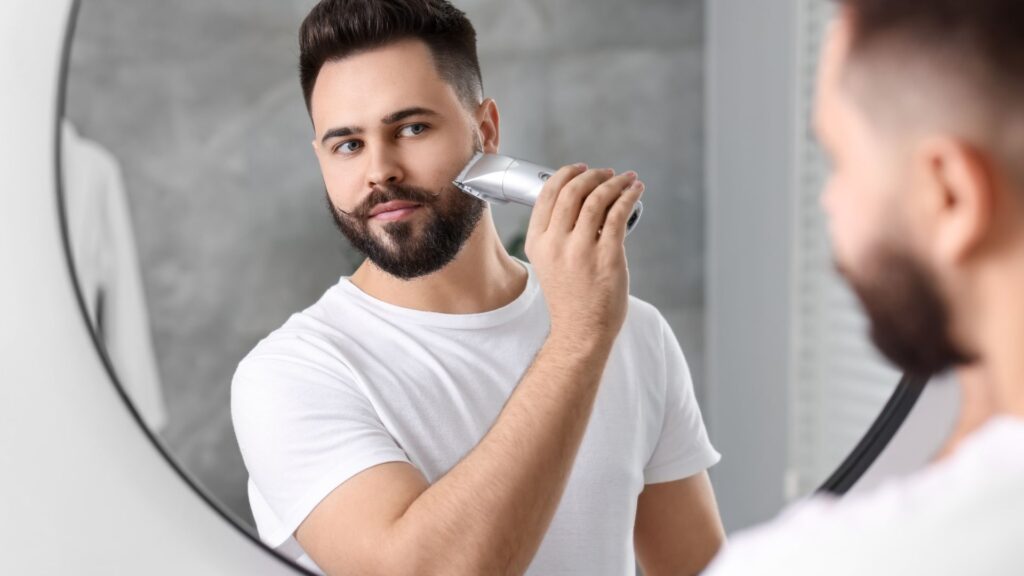
A simple, repeatable sequence works best: splash your face with water to slightly dampen the beard, apply three to five drops of oil, work it through with a comb, then apply a small amount of balm if you want hold, finishing with a brush to distribute evenly and train the direction of growth.

Trimming and Shaping Your Beard at Home Like a Pro
The Golden Rules of Home Trimming
Always trim on dry hair, since wet hair appears longer than it actually is and leads to over-cutting. Start with a longer guard length than you think you need; you can always go shorter, but you can’t add length back. Trim with the grain first to establish a baseline, then against the grain only for detail work.
How to Set and Maintain Your Neckline
Your natural neckline should sit just above your Adam’s apple, following a U-shape rather than a straight line across. Use two fingers above your Adam’s apple as a rough guide, then connect that point to just behind each ear along the jawline. Trim below this line weekly to prevent your neck hair from creeping upward and making the beard look untamed.
Shaping the Cheek Line Without Destroying Your Beard
Cheek lines are more forgiving than necklines since there’s no “correct” universal placement, but a clean line 1 to 2 inches above where your beard naturally starts thinning out generally looks intentional. Use a straight edge or curved template tool if you’re not confident freehanding it, and always work slowly since removing too much cheek hair is a common and frustrating home-grooming mistake.
Fading and Blending — Can You Really Do It at Home?
Fading, the gradual transition from short to long hair blending into the beard, is genuinely difficult to execute at home. It requires steady hands, good lighting, and multiple guard lengths blended seamlessly. Simple fades on short beard styles are achievable with practice and a quality trimmer with multiple guard attachments, but complex fades connecting to a haircut are best left to a barber, at least until you’ve built serious confidence and skill.
Trimming Techniques for Different Beard Styles
| Beard Style | Trimming Focus |
| Stubble | Even length across, sharp neckline only |
| Short boxed beard | Crisp cheek and neck lines, uniform length |
| Full beard | Length maintenance, occasional bulk thinning |
| Long beard | Split-end trimming only, minimal shaping |
| Goatee | Precise mustache-to-chin connection, clean cheeks |
Beard Styles — Choosing the Right One and Maintaining It
The Most Popular Beard Styles Broken Down
| Style | Description | Maintenance Level |
| Stubble | 1 to 3 days of growth, low commitment | Low |
| Short Boxed Beard | Tight, defined, uniform length | Medium |
| Full Beard | Thick, natural length, moderate shaping | Medium |
| Garibaldi | Full, rounded, bushy beard | Low to Medium |
| Ducktail | Full sides tapering to a point at the chin | Medium to High |
| Goatee | Chin-focused, cheeks shaved clean | High |
| Van Dyke | Goatee with a disconnected mustache | High |
| Long Beard | Extended growth past 4 inches | Medium (low trimming, high conditioning) |
How to Match Your Beard Style to Your Face Shape
Refer back to the face shape guidance earlier in this guide, but as a quick rule: rounder faces should lengthen at the chin, square faces should soften with rounded fullness, and longer faces should widen with volume at the sides rather than adding chin length.
Maintaining Short Beards vs. Long Beards — Two Very Different Jobs
| Task | Short Beard | Long Beard |
| Trimming frequency | Weekly | Monthly (split ends only) |
| Product focus | Balm for shape, light oil | Heavy oil and butter for conditioning |
| Washing frequency | 2 to 3 times weekly | 1 to 2 times weekly |
| Styling time | 2 to 3 minutes daily | 5 to 10 minutes daily |
| Common issues | Neckline creep, patchiness visibility | Tangling, split ends, food and debris trapping |
Short beards demand more frequent shaping since any growth is immediately visible. Long beards demand more conditioning since the hair itself, not the shape, is what determines how good it looks day to day.
Transitioning Between Beard Styles Without Starting Over
If you’re growing a short beard into a longer style, resist trimming for at least four to six weeks to let growth catch up evenly before reshaping. If you’re going shorter, do it gradually over two or three sessions rather than one drastic cut, which gives you room to correct mistakes before they’re permanent.
Dealing With Common Beard Problems Head On

Beard Itch — Causes, Cures, and Prevention
Beard itch usually strikes in the first two to four weeks of growth, when new hairs curl back and irritate the skin, or from dry skin underneath the beard. Daily beard oil application is the most effective prevention. Exfoliating the skin underneath with a soft brush two to three times a week also helps significantly.
Beardruff (Beard Dandruff) — What Causes It and How to Beat It
Beardruff results from dry, flaking skin trapped underneath facial hair, often worsened by harsh soaps or infrequent washing. Switching to a moisturizing beard wash, applying oil daily, and gently exfoliating with a boar bristle brush typically resolves it within one to two weeks.
Ingrown Hairs and Razor Bumps in the Beard Area
Ingrown hairs happen when trimmed or shaved hair curls back into the skin instead of growing outward. Prevention includes trimming with the grain, avoiding overly close razor settings on curly-prone areas, and exfoliating regularly. A warm compress can help draw out existing ingrown hairs.
Patchy Beards — Real Fixes and Realistic Expectations
| Issue | Realistic Fix |
| Genetic patchiness | Styling around it (shorter style, strategic shaping) |
| Age-related patchiness | Time; density often improves into late 20s |
| Nutritional deficiency | Correcting diet, not supplements alone |
| Scarring from past irritation | Dermatologist consultation for treatment options |
The honest truth: no product on the market meaningfully “fills in” a patchy beard through the follicle itself. Styling strategy, not miracle serums, is your best tool here.
Beard Acne and Skin Irritation Under the Beard
Beard acne stems from trapped oil, dead skin, and bacteria under facial hair. Daily gentle cleansing, non-comedogenic beard oils, and avoiding excessive touching of the beard throughout the day all reduce breakouts significantly.
Diet, Sleep, and Lifestyle Habits That Affect Your Beard
Foods That Support Beard Growth and Health
| Food Category | Examples | Beard Benefit |
| Lean protein | Chicken, eggs, fish | Provides keratin building blocks |
| Healthy fats | Avocado, salmon, nuts | Supports skin and follicle health |
| Zinc-rich foods | Pumpkin seeds, beef, lentils | Supports hair growth and repair |
| Vitamin D sources | Fatty fish, fortified dairy, sunlight | Linked to follicle health |
| Iron-rich foods | Spinach, red meat, legumes | Supports oxygen delivery to follicles |
How Sleep and Stress Directly Impact Your Facial Hair
Chronic stress elevates cortisol, which can disrupt hair growth cycles and push more follicles into the resting (telogen) phase prematurely. Poor sleep similarly impairs the body’s natural repair processes, including those that support healthy hair follicles. Seven to nine hours of consistent sleep is a genuinely underrated beard-growth tool.
Exercise, Blood Flow, and Beard Growth
Regular exercise improves circulation, which helps deliver oxygen and nutrients to hair follicles, including those on your face. While exercise alone won’t transform a patchy beard, it supports the overall physiological environment that healthy hair growth depends on.
Supplements — What Works and What’s Just Marketing
If you have a confirmed deficiency in biotin, zinc, vitamin D, or iron, supplementing can help restore normal hair growth function. If you’re not deficient, most “beard growth” supplement blends have limited evidence of providing additional benefit beyond what a balanced diet already provides. Save your money unless a blood test tells you otherwise.
The Real Cost of Maintaining a Beard at Home vs. Going to a Barbershop
Breaking Down the Annual Cost of Home Beard Care
| Item | Estimated Annual Cost |
| Trimmer replacement/maintenance | $20 to $40 |
| Beard oil (12 bottles/year) | $120 to $180 |
| Beard balm (6 tubs/year) | $60 to $90 |
| Beard wash (12 bottles/year) | $96 to $144 |
| Razor blades/replacements | $30 to $50 |
| Total Annual Estimate | $326 to $504 |
What a Professional Beard Trim at a Barbershop Includes
A typical barbershop beard trim includes precise shaping with clippers and straight razor edging, a hot towel treatment to soften hair before cutting, and often a finishing application of oil or balm. Many barbers also offer beard washes and conditioning treatments as add-ons.
Home Care vs. Barbershop Care — A Direct Comparison
| Factor | Home Care | Barbershop Visit |
| Cost per session | Near $0 (using owned products) | $25 to $60 depending on region and shop |
| Precision | Depends on skill level | Professional-grade precision |
| Convenience | Immediate, no scheduling | Requires appointment/travel |
| Relaxation factor | Minimal | Hot towels, straight razor experience |
| Best for | Daily maintenance, minor upkeep | Shape resets, special occasions, major style changes |
When to DIY and When to Call in the Professionals
Handle daily oiling, washing, and minor neckline touch-ups yourself. Leave major reshaping, fades, and style transitions to a professional, especially if you’re trying a style you’ve never worn before. If you’re searching “barber near me” because your last home trim went sideways, that’s not a failure, it’s just good judgment.
Getting the Most Value From Both Worlds
The smartest approach blends both. Maintain your beard at home between professional visits every four to six weeks. This keeps costs manageable while ensuring your shape never drifts too far from its intended style.
Building a Beard Routine That Actually Fits Your Life
The 5-Minute Daily Beard Routine
| Step | Time | Action |
| 1 | 30 seconds | Splash beard with water |
| 2 | 30 seconds | Apply beard oil |
| 3 | 1 minute | Comb through to detangle and direct growth |
| 4 | 1 minute | Apply balm if styling hold is needed |
| 5 | 2 minutes | Brush to distribute product and shape |
The Weekly Deep-Care Routine
| Step | Frequency | Action |
| 1 | Weekly | Full wash with beard-specific shampoo |
| 2 | Weekly | Conditioning treatment |
| 3 | Weekly | Neckline and cheek line trim touch-up |
| 4 | Weekly | Exfoliation with a soft brush |
Seasonal Beard Care — Adjusting for Winter, Summer, and Everything Between
Winter air strips moisture fast, so increase oil application slightly and consider a richer beard butter during cold months. Summer heat and sweat call for more frequent washing to prevent buildup and odor. Spring and fall are ideal times for style resets, since growth and shedding patterns often shift with seasonal changes.
Traveling With a Beard — How to Maintain It on the Road
Pack travel-sized oil and balm rather than skipping product for the trip. A compact folding comb takes up almost no space and prevents tangling during flights or long drives. If you’re traveling somewhere unfamiliar and need a trim, searching for a local barber ahead of time beats waiting until your neckline is out of control.
Expert Tips, Trends, and What’s Coming Next in Beard Grooming
What Master Barbers Actually Recommend at Home
Most barbers will tell you the same thing: consistency beats intensity. A man who oils daily and trims his neckline weekly will look sharper than one who occasionally does an elaborate routine once a month. Barbers also consistently recommend investing in a quality trimmer with sharp, replaceable blades over cheap disposable tools that tug and irritate skin.
Current Beard Trends Worth Knowing About
| Trend | Description |
| Textured, natural full beards | Less rigid shaping, more organic movement |
| Short boxed beards with skin fades | Clean, sharp, professional-friendly |
| Return of the mustache-forward look | Van Dyke and horseshoe styles gaining popularity |
| Minimalist stubble with defined lines | Low-maintenance length, high-precision edges |
The Rise of Natural and Clean-Ingredient Beard Products
There’s a growing shift toward beard oils and balms formulated without synthetic fragrances or fillers, driven by demand for products that are gentler on sensitive facial skin. Ingredients like jojoba, argan, and shea butter remain popular because they’re well-tolerated across most skin types.
Where Beard Grooming Technology Is Headed
Smart trimmers with laser guides for even cutting, app-connected devices that track beard growth over time, and increasingly precise ceramic and titanium blade coatings are becoming more common and more affordable, bringing barbershop-level precision closer to the home bathroom counter than ever before.
Frequently Asked Questions
How long does it take to grow a full beard?
Most men need four to six weeks to grow enough length to assess shape and patchiness, and a genuinely full beard often takes two to four months depending on individual growth rate.
Is beard patchiness permanent?
Not always. Many men see improved density into their late twenties. Genetic patchiness that hasn’t changed by your early thirties is more likely to be permanent.
Should I trim during the early growth phase?
Avoid trimming for at least the first four weeks, aside from minor neckline cleanup, to get an accurate picture of your natural growth pattern before shaping.
How often should I wash my beard?
Two to three times per week for most beard lengths, adjusted based on activity level, climate, and skin type.
Can I use regular shampoo on my beard?
Occasionally, yes, but regular use will strip natural oils and cause dryness. Beard-specific wash is formulated to be gentler on facial skin.
What’s the difference between beard oil and beard balm?
Beard oil provides lightweight moisture and shine with no hold. Beard balm adds light-to-medium hold for shaping, along with moisturizing benefits.
How often should I trim my beard?
Weekly for neckline and cheek line maintenance, monthly for overall length adjustments on longer beards.
Where exactly should my neckline sit?
Roughly two finger-widths above your Adam’s apple, following a U-shape rather than a straight line.
Can I fade my own beard at home?
Simple fades are achievable with practice and a quality trimmer with multiple guards, but complex fades connecting to a haircut are best done by a professional barber.
Why does my beard itch so much?
Beard itch is common in the early growth stages due to hairs curling back into the skin, or from dry skin underneath longer, established beards.
What causes beardruff?
Dry, flaking skin trapped under facial hair, often worsened by harsh soaps, infrequent washing, or lack of moisturizing.
Does diet really affect beard growth?
Yes, adequate protein, zinc, and vitamin D support healthy hair growth, though diet alone won’t override genetic growth potential.
Conclusion — A Final Word From the Chair
Every barber worth their chair will tell you the same thing: grooming isn’t vanity, it’s respect, respect for yourself and for the people you show up in front of every day. A beard is one of the few grooming choices a man makes entirely on his own terms, and treating it with real care is a quiet form of self-respect that other people notice even when they can’t quite articulate why.
Week one, build your kit and start the five-minute daily routine. Week two, add weekly washing and neckline touch-ups. Week three, dial in your product amounts and refine your cheek line. Week four, evaluate your progress and, if needed, book a visit with a professional barber to reset your shape and get expert feedback on what’s working.
The men with the sharpest beards aren’t necessarily the ones with the best genetics. They’re the ones who show up for their routine every single day, rain or shine, busy schedule or not. Consistency, more than any product or tool on this list, is what separates a beard that turns heads from one that just exists on someone’s face.