
Walk into any barbershop with a screenshot of a celebrity’s fade and you’re already starting the conversation wrong. That haircut worked because of the hair underneath it, not because of the clippers used or the angle of the photo. Your hair type, meaning your texture, density, porosity, and growth pattern, determines what a style will actually look like on your head. This guide breaks down every hair type, explains the science behind why your hair behaves the way it does, and shows you how to choose a cut that works with your biology instead of against a trend that was never built for you.
Key Takeaways
- Hair type (texture, density, porosity, growth pattern) should always be the first factor in choosing a haircut, before trends or even face shape.
- Straight, wavy, curly, and coily hair each have distinct strengths and limitations that determine which cuts will hold up day to day.
- Wet hair and dry hair can look drastically different in length and shape, especially for curly and coily textures, so barbers must cut with shrinkage in mind.
- Density and porosity affect how a cut blends, how long it lasts, and which products will actually work for your hair.
- The most reliable way to get a great haircut is to describe your hair type accurately to your barber and choose a specialist who has demonstrated skill across multiple textures.
The Mirror Doesn’t Lie — Why Your Hair Type Should Drive Every Haircut Decision
The gap between trends and reality in the barbershop chair
Every barber has lived this moment. A client sits down, pulls up a photo, and asks for exactly that. The photo shows a high skin fade with a textured crop on top, styled with enough product to survive a hurricane. The client has fine, straight hair with low density. Fifteen minutes later, the cut looks nothing like the picture, not because the barber lacks skill, but because straight, low-density hair cannot produce the same textured volume as the thick, wavy hair in the photo.
This is the single biggest disconnect in modern haircuts. Social media spreads styles fast, but it rarely explains why those styles worked on that particular head. A good barber’s job isn’t to recreate a photo. It’s to translate the spirit of a request into something your actual hair can deliver.
What hair type actually means (texture, density, porosity, growth pattern)
“Hair type” gets thrown around loosely, but it actually refers to four distinct characteristics working together:
- Texture: Whether hair strands are straight, wavy, curly, or coily. This is usually described using the Andre Walker Hair Typing System, which ranges from Type 1 (straight) to Type 4 (coily).
- Density: How many hair strands grow per square inch of scalp. Density is separate from thickness of an individual strand.
- Porosity: How well your hair absorbs and retains moisture, based on the condition of the hair cuticle.
- Growth pattern: The direction hair naturally grows from the scalp, which creates cowlicks, swirls, and hairline shapes.
Each of these factors changes how a haircut falls, how long it holds its shape, and how it needs to be maintained. A cut that ignores any one of them is a cut built on guesswork.
Why barbers assess hair before they even pick up the clippers
Experienced barbers run a quick mental checklist before a single clip of hair hits the floor. They look at how the hair falls naturally, check for cowlicks near the crown and hairline, run fingers through to feel density, and ask how the client typically styles it day to day. This assessment takes seconds, but it’s the difference between a haircut that looks good leaving the chair and one that still looks good on day four without a stylist’s hands involved.
The Science Behind Hair — What Your Follicles Are Actually Doing
Follicle shape and its direct impact on texture
Hair texture is determined almost entirely by the shape of the hair follicle beneath the scalp. Round follicles produce straight hair because the strand grows evenly in cross-section. Oval follicles produce wavy or curly hair, and the more asymmetrical the follicle, the tighter the curl pattern. Flat, ribbon-shaped follicles produce coily hair, which is why coily strands often look flat in cross-section under a microscope rather than round. This single structural detail at the follicle level is why no amount of cutting technique can change your fundamental texture. You can shape it, thin it, and style it, but the follicle dictates the starting point.
The hair growth cycle and why it affects cut longevity
Hair grows in three phases: anagen (active growth), catagen (transition), and telogen (resting, followed by shedding). The average scalp hair grows about half an inch per month during anagen, though this varies by individual and by hair type. Coarser, curlier hair tends to have a shorter visible growth rate because the curl pattern “uses up” length through coiling, even though the strand is still growing at a similar rate underneath.
This matters for haircut longevity. A tight fade on coily hair may need a touch-up every two weeks because new growth is immediately visible at the root, while the same fade on straight hair might stretch to three or four weeks before it needs attention.
Genetics, hormones, and why your hair behaves the way it does
Hair texture, density, and even your hairline shape are largely inherited traits, controlled by multiple genes rather than a single dominant one. Hormonal shifts, particularly in androgen levels, also influence hair thickness and can contribute to pattern thinning over time. This is why two brothers with similar genetics can still have noticeably different hair density or texture by their thirties.
What dermatology research says about scalp health and cut performance
Scalp health directly affects how hair grows and how a haircut performs over time. According to dermatology research published in journals like the Journal of the American Academy of Dermatology, conditions such as seborrheic dermatitis, excess oil production, or chronic dryness can all affect hair strand integrity and growth patterns. A healthy scalp environment supports stronger, more predictable hair growth, which means your haircut holds its shape longer and grows out more evenly.
Straight Hair — Its Strengths, Its Weaknesses, and What Works Best
Why straight hair holds clean lines so well
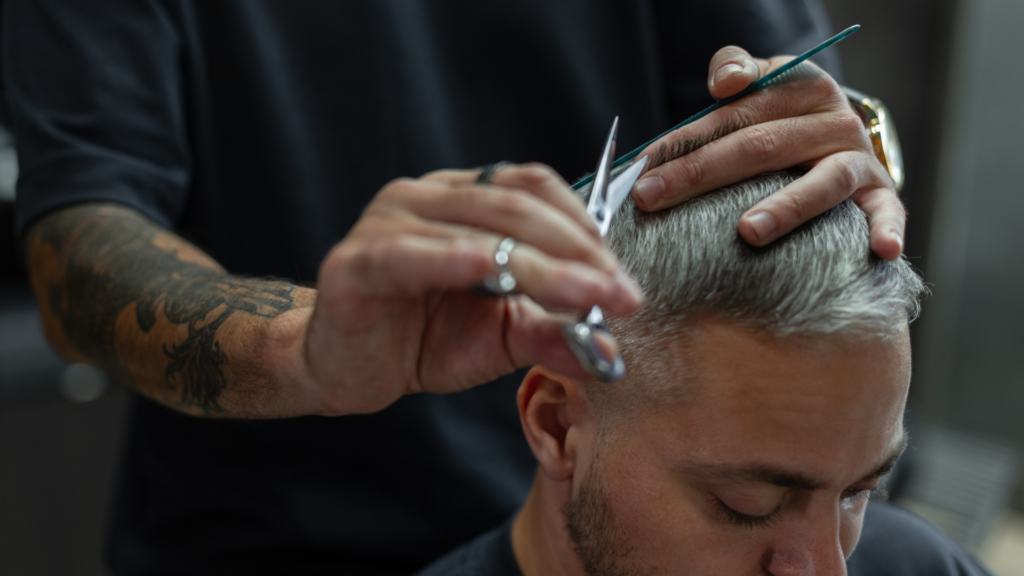
Straight hair (Type 1) reflects light evenly along the strand because of its round follicle shape, which is why straight hair often looks shinier and why sharp, clean lines like a crisp fade or a precise part show up so clearly. There’s no curl pattern to disrupt the line, so geometric cuts read exactly as intended.
The styling traps straight-haired men fall into
The biggest mistake with straight hair is over-processing it with heavy products chasing volume that isn’t there naturally. Straight hair, especially fine straight hair, gets weighed down fast. Too much pomade or wax flattens it further instead of lifting it.
Best haircuts for straight hair types
- Textured crop: Works well because straight hair holds a clean silhouette while the textured top adds dimension.
- Classic taper: Clean, low-maintenance, and shows off straight hair’s natural shine.
- Slick back: Straight hair’s smooth surface makes it ideal for this polished look.
- Side part: A timeless option that straight hair holds with minimal product.
Products that work with straight hair (not against it)
Lightweight products are key. Clay-based products add texture without excess shine, while lightweight pomades offer hold without the greasy weight that heavier waxes bring. Avoid thick creams unless you have coarse straight hair that needs extra control.
Wavy Hair — The Most Versatile Texture and How to Use It
Why wavy hair is the easiest texture to work with
Wavy hair (Type 2) sits in the middle of the texture spectrum, giving it natural volume and movement without the shrinkage or frizz challenges that come with tighter curl patterns. This versatility is why many barbers consider wavy hair the most forgiving texture to cut.
The common mistake of fighting the wave
A common error is cutting wavy hair as if it were straight, using blunt, heavy layers that ignore the natural wave pattern. This often results in a cut that looks fine the day it’s done but falls apart or looks uneven once the wave reasserts itself over the following days.
Best haircuts for wavy hair
- Textured quiff: Uses the natural wave for lift and movement at the front.
- Medium-length fringe: Lets waves fall naturally without excess bulk.
- Fade with wavy top: Creates contrast between tight sides and textured volume on top.
- Side-swept styles: Waves naturally support this fall without heavy styling.
Maintenance and product strategies for wavy hair
Sea salt sprays and lightweight creams enhance the natural wave pattern without flattening it. Avoid heavy oils that weigh waves down into limp strands. Air-drying or diffusing on low heat tends to produce better wave definition than rough towel-drying.
Curly Hair — Working With the Curl, Not Against It
How curl pattern affects cut length (wet vs. dry shrinkage)
Curly hair (Type 3) can shrink by 30 to 50 percent between its wet and dry state, depending on curl tightness. This means a barber cutting curly hair wet without accounting for shrinkage risks cutting it far shorter than intended once it dries and the curls spring back up. Skilled barbers either cut curly hair dry or account for shrinkage carefully when cutting wet.
The history of barbershops and curly hair
For decades, mainstream barbering education focused heavily on straight and wavy hair, leaving many barbers undertrained in cutting curly textures properly. This gap pushed many curly-haired clients toward specialty curl salons rather than traditional barbershops. In recent years, barbering education has expanded significantly to include curl-specific cutting techniques, and more shops now train specifically in textured hair.
Best cuts and styles for curly hair
- Curly undercut: Keeps curls on top while reducing bulk on the sides.
- Curly fringe: Shorter curls at the front provide shape without overwhelming volume.
- Layered curls: Reduces weight so curls can bounce rather than hang flat.
- Curly crop: A shorter, low-maintenance option that still defines the curl pattern.
Cutting techniques that honor curly texture
Many barbers now use a technique called curl-by-curl cutting, shaping each curl individually rather than cutting straight across sections. This respects the fact that curls don’t fall in uniform lines, and it prevents the “triangle” effect where curly hair looks pyramid-shaped due to uneven layering.
Coily Hair — Precision, Pattern, and a Different Kind of Expertise
What coily hair demands from a barber
Coily hair (Type 4) has the tightest curl pattern and the highest shrinkage rate, often 50 to 75 percent between wet and dry length. It also tends to have lower natural moisture retention due to the shape of the cuticle, making it more prone to dryness and breakage if handled carelessly. Cutting coily hair well requires precise attention to pattern, since even small inconsistencies become very visible once the hair is styled.
How the Line Up Haircut became a precision art form in coily hair culture
The Line Up Haircut, which defines a crisp, sharp edge along the hairline, temples, and sideburns, became a cultural staple largely through barbershop traditions rooted in Black communities. A clean line up is considered a mark of a barber’s precision and attention to detail, and it remains one of the most requested finishing touches for coily and curly hair types specifically because sharp lines contrast beautifully against dense curl patterns.
Best cuts and styles for coily hair types
- High top fade: Classic and versatile, showcasing volume on top with sharp sides.
- Tapered afro: Maintains natural volume while cleaning up the edges.
- Twist-out friendly cuts: Shaped specifically to support twist or braid-out styling.
- Low fade with line up: A sharp, clean finish that highlights the hairline.
Scalp health and moisture considerations unique to coily hair
Because coily hair retains moisture less effectively than other textures, scalp dryness is a common concern. Dermatologists often recommend moisturizing scalp oils and reduced washing frequency for coily hair types to preserve natural oils, which also helps haircuts hold their shape and shine longer between visits.
Hair Density — Why How Much Hair You Have Changes Everything
Thin hair vs. thick hair: two completely different haircut strategies
Density refers to the number of strands per square inch, completely separate from texture. You can have thick, coarse strands that are low in density, or fine strands that are extremely high in density. Low-density hair needs cuts that create the illusion of fullness, while high-density hair often needs thinning techniques to prevent bulk.
| Density Level | Common Challenge | Recommended Approach |
| Low density | Scalp visibility, limp styling | Shorter cuts, textured layers, avoid heavy products |
| Medium density | Balanced but can look flat if cut wrong | Standard layering, moderate product use |
| High density | Excess bulk, slow drying, hard to style | Thinning shears, point cutting, lightweight products |
How density affects fade blending and taper appearance
Fades blend more seamlessly on higher-density hair because there’s more hair to gradually transition in length. Low-density hair can make fades look patchy or overly stark if not blended carefully, which is why barbers often adjust clipper guard transitions more gradually on thinner hair.
Volume illusion techniques for thin hair
Point cutting, texturizing at the ends, and keeping length shorter overall all help create the appearance of fuller hair. Avoiding overly long layers is key, since weight pulls thin hair flat.
Managing bulk in dense, thick hair
Thinning shears, slide cutting, and strategic layering reduce bulk without sacrificing length. Many barbers also recommend thick-haired clients visit more frequently to manage volume before it becomes unruly.
Hair Porosity and Scalp Condition — The Hidden Factors No One Talks About

What porosity means and why it matters for styling
Porosity describes how easily hair absorbs and retains moisture, based on how tightly the hair’s outer cuticle layer is sealed. Low porosity hair resists moisture absorption, making it prone to product buildup. High porosity hair absorbs moisture quickly but loses it just as fast, which often means more frizz and less styling longevity.
How scalp health affects how a haircut sits and grows out
A dry, flaky, or inflamed scalp can affect hair growth direction and texture consistency, which in turn affects how evenly a haircut grows out. Dermatology sources note that conditions like dandruff or psoriasis can create patchy growth patterns that complicate even the most precise haircut.
Product compatibility based on porosity level
| Porosity Level | Best Product Type | Avoid |
| Low porosity | Lightweight, water-based products | Heavy oils and butters that sit on top of hair |
| Medium porosity | Balanced leave-ins and light oils | Overloading with multiple heavy products |
| High porosity | Rich creams and sealing oils | Harsh, drying alcohols in styling products |
Growth Patterns, Cowlicks, and Hairlines — The Structural Reality of Your Head
Why growth direction matters more than most men realize
Hair doesn’t grow straight up from the scalp. It grows at angles determined by follicle direction, which creates natural swirls, whorls, and cowlicks. Ignoring growth direction when cutting can produce a style that looks correct in the chair but flips up or parts unpredictably once you leave the shop.
Working with cowlicks instead of against them
A cowlick at the crown or hairline can disrupt an otherwise clean style if a barber cuts against it rather than accounting for its direction. Skilled barbers often leave slightly more length around a cowlick or angle the cut to guide the hair in a direction that controls rather than fights the swirl.
Hairline shape and how it should influence style selection
Hairline shapes vary widely, from straight across to widow’s peaks to uneven, receding, or rounded patterns. A style that requires a perfectly straight fringe will look off on a hairline with a strong widow’s peak unless adjusted to work with that natural shape rather than against it.
Trends vs. Hair Type — A Direct Confrontation

Why trend-driven haircuts fail so many men
Trends are designed to look good in photos, often under ideal lighting, on models selected partly for their hair’s cooperation with that specific style. When a client requests a trend without adapting it for their own texture and density, the result frequently falls short of expectations, not because the barber failed, but because the request ignored biology.
The social media effect on unrealistic hair expectations
Platforms like Instagram and TikTok have accelerated trend cycles dramatically, and according to industry commentary from sources like IBISWorld’s personal care services reports, demand for specific “viral” cuts has created rising client dissatisfaction when results don’t match expectations shaped by heavily edited or texture-specific content.
How to adapt a trending style to your actual hair type
The fix is simple: describe the trend’s key features (length, fade height, texture level) to your barber and ask how it translates to your specific hair type rather than requesting an exact replica. A good barber will tell you honestly what will and won’t translate.
Trend vs. hair type comparison table across 6 popular styles
| Trending Style | Straight Hair | Wavy Hair | Curly Hair | Coily Hair |
| Textured crop | Needs product for texture | Works naturally well | Needs length control | Needs tighter taper |
| Mullet | Holds shape cleanly | Good natural movement | Requires shrinkage planning | Volume-heavy, needs shaping |
| Slick back | Excellent fit | Moderate, needs product | Difficult, curls resist | Very difficult without heavy product |
| Buzz cut | Clean and even | Slightly uneven texture | Reveals tight curl pattern | Reveals coil pattern clearly |
| High fade with fringe | Sharp and defined | Soft, natural fringe | Needs curl-specific cutting | Needs line up precision |
| Afro-inspired volume | Not achievable naturally | Partial volume possible | Good natural fit | Best natural fit |
Face Shape Still Matters — But Only After Hair Type
The correct order of decision-making (hair type first, face shape second)
Face shape guidance is popular in style articles, but it only works as a second filter after hair type has been established. A recommendation based purely on face shape (“round faces should avoid flat tops”) assumes hair that can even achieve the silhouette being discussed.
How hair type modifies face-shape recommendations
A round face might generally benefit from height on top to elongate the face, but that advice looks completely different executed in straight hair (a styled quiff) versus coily hair (a tapered afro). The underlying face-shape principle holds, but the hair type determines the real-world execution.
Combined matrix of hair type and face shape recommendations
| Face Shape | Straight Hair | Wavy Hair | Curly Hair | Coily Hair |
| Round | Textured quiff for height | Wavy quiff | Curly fringe with height | Tapered afro |
| Square | Side part | Textured crop | Layered curls | High top fade |
| Oval | Most styles work | Most styles work | Most styles work | Most styles work |
| Long | Fringe for width illusion | Side-swept waves | Curly fringe | Fuller sides, less top height |
Age, Thinning, and Changing Hair — Adjusting Your Style Over Time
How hair texture and density change with age
Hair often becomes finer and less dense with age, partly due to hormonal changes and a gradual shortening of the anagen growth phase over successive growth cycles. Some men also notice their natural curl pattern loosens slightly over the decades.
Haircuts that age well for men dealing with thinning
Shorter cuts generally age better with thinning hair because they reduce the visual contrast between thinning areas and fuller ones. Crew cuts, tight crops, and shorter tapers tend to look intentional rather than accidental compared to longer styles that reveal gaps more obviously.
When to change your style because your hair has changed
If you’re reaching for more product than you used to just to achieve the same look, or if your part is widening, it’s usually a sign your density has shifted enough to warrant a style change rather than forcing the old cut to keep working.
Talking to Your Barber About Your Hair Type
How to describe your hair type accurately before the cut starts
Rather than naming a style you saw online, describe your hair’s actual behavior: does it curl when it air-dries, does it get frizzy in humidity, does it feel thick or thin when wet. This gives your barber far more useful information than a single reference photo.
What a great barber does when they assess your hair
A great barber will run fingers through your hair dry and wet, ask about your daily styling routine, and check for cowlicks or growth pattern quirks before making a single cut. They’ll also ask what’s frustrated you about past haircuts, which often reveals texture mismatches from previous visits.
Red flags that a barber isn’t working with your texture
If a barber cuts curly or coily hair only when wet without discussing shrinkage, dismisses questions about your hair’s natural behavior, or insists on a style without acknowledging your texture’s limitations, those are signs worth noting for your next appointment.
Products, Tools, and Techniques Matched to Hair Type
Product type by hair texture and density
| Hair Type | Best Product Category |
| Straight | Lightweight pomade, clay |
| Wavy | Sea salt spray, light cream |
| Curly | Curl cream, leave-in conditioner |
| Coily | Heavy butter, scalp oil |
Cutting tools and techniques by texture
Shears generally offer more control for curly and coily textures, where precision matters most, while clippers remain the standard for fades and tapers across all textures. Texturizing shears and point cutting are especially valuable for reducing bulk in dense or coily hair.
Home maintenance routines by hair type
Straight hair typically needs daily washing tolerance and minimal product. Wavy hair benefits from a “scrunch and go” air-dry routine. Curly and coily hair generally do best with reduced washing frequency, using conditioner-rich routines like co-washing to preserve moisture between barber visits.
Finding a Barber Who Actually Understands Your Hair
What to look for in a barber skilled across multiple textures
Look for barbers who ask detailed questions about your hair’s natural behavior rather than jumping straight to the clippers. A barber comfortable across textures will usually have visible experience with a range of client hair types, not just one.
How to evaluate a portfolio for texture-specific skill
Check a barber’s portfolio for variety. A barber who only shows straight-hair fades may not have the experience needed for curly or coily clients, and vice versa. Look specifically for clean line up work if that’s part of what you’re after, since it’s one of the clearest indicators of precision skill.
Using ‘barber near me’ searches to find the right specialist
A simple “barber near me” search can surface dozens of options, but filtering by reviews that specifically mention your hair type (curly specialist, fade expert, coily hair barber) will get you much closer to the right match than general proximity alone.
Frequently Asked Questions
Does hair type really matter more than the haircut style itself?
Yes. The style is really just a template. Your hair type determines whether that template will look the way you expect, which is why the same haircut name can produce completely different results on different heads.
Can a barber change my natural hair texture permanently?
No. A haircut shapes how your texture is displayed, but it cannot change the underlying follicle structure that determines whether your hair is straight, wavy, curly, or coily.
Should curly or coily hair be cut wet or dry?
Many barbers prefer cutting curly and coily hair dry, or at least checking the dry result during the cut, because of significant shrinkage between wet and dry states. This helps avoid cutting the hair shorter than intended.
How often should I get a haircut based on my hair type?
Shorter, tighter styles like fades on coily hair often need touch-ups every two to three weeks due to fast-appearing new growth, while longer or looser styles on straight or wavy hair can often stretch to four to six weeks.
Is the Line Up Haircut only for certain hair types?
While the Line Up Haircut is especially associated with curly and coily hair culture, sharp hairline definition can be added to nearly any hair type as a finishing detail.
Why does my hair look different on wash day versus the rest of the week?
This is often related to porosity and product buildup. Low porosity hair can look flatter as oils build up over days, while high porosity hair often looks its best right after washing before frizz sets in.
Can my hair type change as I get older?
Density and sometimes curl pattern can shift with age due to hormonal changes and natural variations in the hair growth cycle, which is why a style that worked in your twenties might not suit your hair in your forties.
What’s the best way to find a barber who understands my specific hair type?
Search with specific terms tied to your texture, check portfolios for relevant examples, and read reviews mentioning your hair type specifically rather than relying on general ratings alone.
Your Hair, Your Rules — A Final Decision Framework
The personal hair type checklist before your next appointment
Before your next visit, get clear on four things: your texture (straight, wavy, curly, coily), your density (thin, medium, thick), your porosity (how your hair handles moisture), and your growth pattern (any cowlicks or hairline quirks). Walking in with this knowledge puts you and your barber on the same page before a single clip happens.
How to commit to a style that works with your biology
Trends will keep cycling through barbershops, but your hair’s fundamental biology isn’t going anywhere. Choosing cuts that respect your actual texture and density means fewer disappointing appointments and far less time spent fighting your hair every morning.
Final words from behind the chair
Great haircuts aren’t about chasing the newest style spotted online. They’re about understanding what’s growing out of your head and shaping it with skill and respect for what it naturally wants to do. Bring your real hair into the conversation, not just a screenshot, and you’ll walk out of that chair with a cut that actually works for you, not just for the camera.