

Why Every Age Deserves a Different Approach in the Chair
The Day a Kid Climbs Into the Big Chair
I’ve been behind the chair for over twenty years. I still remember the first toddler I ever cut. He gripped the armrest of that cracked leather chair like a pilot in turbulence. His dad stood two feet away, phone raised, hands shaking worse than the kid’s.
The clippers hadn’t even turned on yet. The smell of talc and Barbicide hung in the air. I knelt down, looked him in the eye, and said, “Buddy, this chair goes up like a rocket. Want to see?” One pump of the hydraulic pedal later, he was grinning. That’s when I learned the first rule of cutting kids: you’re not cutting hair first. You’re earning trust first.
That same boy came back at sixteen asking for a mid skin fade with a hard part. Same chair, same barber, completely different job. Between those two visits, nearly everything changed: his hair, his head shape, his attention span, his opinions, and the tools I reached for.
This guide walks you through that whole journey, year by year.
What Actually Changes From Toddler to Teen
People assume a kid’s cut is just a smaller version of a man’s cut. It isn’t. Four things shift as a boy grows, and each one changes how a barber works.
- The hair itself. Baby hair is fine, soft, and unpredictable. Teen hair is thicker, oilier, and often changes texture entirely.
- The head and scalp. A toddler’s skull is still developing. A teen’s scalp is dealing with hormones, oil, and sometimes acne along the hairline.
- The kid’s ability to sit still. A two-year-old gives you about four minutes of patience. A teenager will sit for forty-five if the fade comes out right.
- Who’s making the decisions. At two, Dad picks the style. At eight, the kid starts having opinions. At fifteen, the kid runs the show and Dad pays.
Every technique a good barber uses, from tool choice to talking style, flows from those four shifts.
What You’ll Take Away From This Guide
Whether you’re a father booking your son’s first appointment, a gift-buyer grabbing a barbershop voucher, or a grown man curious about how your own childhood cuts were done, here’s what you’ll get:
- Age-by-age breakdowns of the tools, techniques, and styles that work best
- Clear comparisons like scissors vs. clippers, barbershop vs. kitchen trims, and low fades vs. high fades
- Real stories from the chair that show what works when things go sideways
- Cost and budgeting guidance so you know what you’re paying for
- A practical action plan you can use before your next visit
To understand why techniques change, you first need to understand what’s happening on top of your kid’s head as he grows.
How a Boy’s Hair Grows and Changes Over the Years
Baby Hair and Why It Falls Out
Here’s something that surprises a lot of new dads. According to the American Academy of Dermatology, we’re born with all the hair follicles we’ll ever have, roughly 100,000 on the scalp. No new ones get added later. What changes is the hair those follicles produce.
Newborn hair is often fine and wispy. Many babies lose much of it in the first six months. The American Academy of Pediatrics describes this hair loss as normal. Hormones from pregnancy drop off, and the hair shifts into a resting phase before shedding. Friction from lying on the back makes it worse, which is why so many babies have that bald patch at the back of the head.
What grows back can surprise you. I’ve seen kids born with jet-black hair come back blond by age two. I’ve seen straight-haired babies sprout curls by their third birthday. That’s why I tell parents not to judge their kid’s “real” hair until after the first year or so.
For a barber, this means baby hair needs a light touch. It’s fragile, it moves unpredictably, and it doesn’t hold a line well. You’re shaping, not sculpting.
Growth Rates, Density, and Texture Shifts
The American Academy of Dermatology notes that scalp hair grows about half an inch per month, roughly six inches a year. Kids’ hair can feel like it grows faster because a quarter inch matters a lot more on a small head with a short style.
Through early childhood, hair gets denser and the strands get thicker. By about age five or six, most kids have settled into their long-term texture. That’s when you start seeing the real growth patterns clearly: the crown swirl, the cowlick at the front, the way hair lies on the sides.
| Age Stage | Typical Hair Characteristics | What It Means for the Barber |
| 0 to 12 months | Fine, sparse, may shed heavily | Usually no cut needed; trim only if hair is in eyes |
| 1 to 3 years | Soft, wispy, texture still shifting | Scissor work, quick trims, minimal clipper use |
| 4 to 7 years | Denser, texture settling, cowlicks visible | Can handle clippers and basic tapers |
| 8 to 12 years | Thicker, consistent texture | Fades, line-ups, and more structure possible |
| 13 to 18 years | Coarser, oilier, possible texture change | Precision fades, razor detail, styling products |
Puberty, Oil, and the Teen Scalp
Puberty is the big curveball. The American Academy of Pediatrics notes that puberty in boys typically starts between ages 9 and 14. Hormones ramp up the sebaceous glands, which means more oil on the scalp and face.
You’ll see it in the chair. A kid who used to go two weeks without washing and still looked fine suddenly has greasy hair by day two. Hair texture can shift too. Some boys who had straight hair develop waves. Some see their hairline start to shift into a more mature shape, which is normal and not balding.
The skin changes matter as well. The American Academy of Dermatology reports that about 85 percent of people between ages 12 and 24 experience at least minor acne. When a barber is doing a line-up on a teen, he’s often working around breakouts on the forehead and temples. That changes how you use a trimmer or razor along the hairline.
Knowing the science is one piece. The other piece is knowing how boys have sat in barber chairs for generations, because a lot of today’s styles come straight from history.
A Short History of Boys in the Barber Chair
From Barber-Surgeons to Booster Seats
Barbering is old. Really old. In 1540, England’s barbers and surgeons merged into a single guild known as the Company of Barber-Surgeons. Barbers pulled teeth, let blood, and trimmed beards. The red and white barber pole comes from that era. The red stood for blood and the white for bandages.
The surgeons broke away in 1745, and barbers went back to hair. By the late 1800s and early 1900s, American barbershops had become neighborhood hubs. Fathers brought their sons in on Saturday mornings. Barbers kept a wooden board laid across the armrests so small boys could sit high enough to cut. Some shops had carved horse heads or toy car seats for the little ones.
That booster board is still around in many shops. Ours sits behind the counter, worn smooth by thousands of little legs.
Decades of Boys’ Styles at a Glance
Every generation of boys has had its signature look. Here’s a quick timeline.
| Era | Popular Boys’ Style | Why It Took Off |
| 1940s to 1950s | Crew cut, flattop, butch cut | Military influence, easy upkeep |
| 1960s | Mop-top, longer bangs | The Beatles and British pop culture |
| 1970s | Shaggy layers, afros | Counterculture, Black pride movement |
| 1980s | Hi-top fade, mullet | Hip-hop culture, rock stars |
| 1990s | Bowl cut, curtains, Caesar | TV stars, boy bands, athletes |
| 2000s | Spiky gel, faux hawk | Pop-punk, soccer stars |
| 2010s | Undercut, pompadour, man bun | Retro revival, social media |
| 2020s | Textured crop, burst fade, modern mullet | TikTok, athletes, gaming culture |
Funny thing is, styles circle back. The mullet came roaring back in the 2020s, and I’ve had dads laugh in the chair telling me they rocked the exact same cut in 1987.
First-Cut Traditions Around the World
The first cut means something in almost every culture. It’s a milestone, the same as first steps or first words.
| Tradition | Culture | Typical Age | What Happens |
| Upsherin | Jewish (especially Orthodox) | 3 years | Family and guests snip locks; sidelocks are left |
| Mundan | Hindu | 1 to 3 years | Head is shaved to remove past-life impurities |
| Dah üs | Mongolian | 2 to 5 years | Relatives each cut a lock and give a gift |
| Keepsake lock | Common in the U.S. and Europe | 1 to 2 years | Parents save a curl in an envelope or baby book |
| First-cut certificate | American barbershops | 1 to 3 years | Shop gives a signed certificate with a photo |
At our shop, every first-timer goes home with a certificate and a lock of hair in a little envelope. It costs us almost nothing. Parents treasure it for decades.
That history matters, but the big question for most dads is a practical one: when should your son actually sit for his first cut?
When Should Your Child Get His First Cut?
Signs Your Little One Is Ready
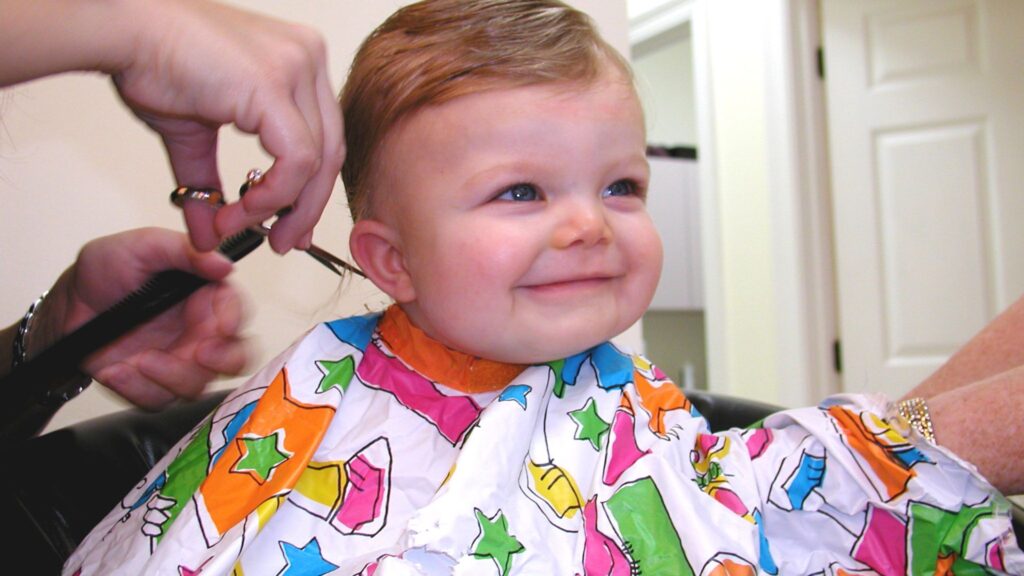
There’s no fixed birthday for it. Most boys get their first cut between 12 months and 2 years old, but it depends on the hair. Some babies are bald until 18 months. Others have a full head of hair by six months.
Here are the signs I look for:
- Hair falling into the eyes. If he’s constantly squinting or pushing hair away, it’s time.
- Uneven growth. Baby hair often grows long on top and patchy on the sides. A light trim evens it out.
- Tangles or mats at the back. Especially common with curly or textured hair.
- Food in the hair. If his bangs keep dipping into the oatmeal, you know.
- He can sit up steadily. This is a big one. A kid who can sit on your lap without flopping makes the job much safer.
A kid’s first haircut isn’t just grooming. It’s a rite of passage. Don’t rush it because Grandma says so, and don’t put it off out of nostalgia if the hair is causing problems.
Timing the Appointment Like a Pro
Timing makes or breaks the visit. I tell every dad the same thing: book around his schedule, not yours.
- After a nap, never before. A tired toddler is a ticking clock.
- After a snack. Hungry kids melt down fast.
- Weekday mornings if you can. Shops are quieter, barbers are fresh, and there’s less noise.
- Avoid right before a big event. Don’t book the first cut the day before family photos. If something goes sideways, you want time to grow it out.
Call ahead and ask which barber is best with little kids. Every shop has one. Ours is a guy named Ray who keeps a basket of rubber dinosaurs at his station. Kids line up for him.
Barbershop vs. Kitchen Chair: Which Is Better for the First Cut?
Plenty of parents do the first trim at home. That’s fine. But there are real trade-offs.
| Factor | Barbershop | Home Kitchen Trim |
| Skill level | Trained professional with steady hands | Parent with good intentions |
| Tools | Professional shears, quiet trimmers, booster seat | Kitchen scissors, maybe a cheap clipper set |
| Safety | Barbers trained to work around squirmy kids | Higher risk of nicks near ears |
| Experience | Milestone moment, certificate, photos | Cozy and familiar |
| Cost | Usually $15 to $30 for a toddler | Free (plus the cost of a fix later) |
| Kid’s comfort | New environment can be scary | Familiar setting, less anxiety |
My honest take? If your kid is very anxious, a home trim for the first round isn’t the end of the world. But the barbershop builds a habit. Kids who come in young learn the chair isn’t scary. That pays off for years.
Once you’ve decided to come in, here’s what a good barber actually does with an infant or toddler in the chair.
The First Cut: Techniques for Infants and Toddlers (Ages 1 to 3)
Setting Up the Chair and the Room
With toddlers, setup is half the job. Before the kid even sits, a good barber prepares everything.
Seating comes first. Most toddlers do best on a parent’s lap. Dad sits in the chair, kid sits on Dad, and a cape goes over both of them. Some kids prefer the booster seat or a novelty car seat. Let the kid choose if he’s old enough to point.
Tools are laid out within reach. You don’t want to turn your back on a two-year-old to grab a comb. Shears, spray bottle, a soft neck brush, and a small trimmer all sit ready.
The cape is loose and light. Some kids panic when something tightens around their neck. I use a soft cape fastened loosely, or a towel draped over the shoulders.
Distractions go up front. A tablet with a cartoon, a lollipop, a toy to hold. I’m not above singing badly. Whatever buys you five calm minutes.
Scissors vs. Clippers for Toddlers
This is the most common question I get from dads. Here’s the breakdown.
| Factor | Scissors | Clippers |
| Noise | Quiet snip | Buzzing that can scare little ones |
| Vibration | None | Can feel ticklish or alarming |
| Precision on fine hair | Excellent for soft, wispy hair | Fine baby hair can get pushed down, uneven |
| Speed | Slower | Faster for short, even lengths |
| Safety with squirming | Requires steady hands and blunt-tip shears | Guards protect skin, but movement can still cause nicks |
| Best use | Bangs, around ears, overall shaping | Neckline cleanup, short sides if kid tolerates it |
For most toddlers, scissors win. Fine baby hair doesn’t feed well into clipper blades, and the buzz can turn a calm kid into a siren. I’ll use a small, quiet cordless trimmer only to tidy the neck, and only if the kid’s handling things well.
A tip for dads: let him hold the trimmer while it’s off. Then turn it on and let him feel it buzz against his hand. Ten seconds of that can save twenty minutes of tears.
Speed, Distraction, and Saving the Lock
With toddlers, speed matters more than perfection. A toddler cut should take about ten to fifteen minutes. Here’s how I work:
- Mist lightly. A spray bottle can scare kids, so I spray my comb or hand instead of the head.
- Front first. I clear the bangs away from the eyes while the kid is calm.
- Sides and ears. I fold the ear down gently with my thumb and snip around it.
- Back last. By then the kid is usually done sitting, so the back gets a fast, clean pass.
- Save the lock. Before I start, I clip one curl from the back and set it aside in an envelope.
If the kid melts down halfway, I stop. A half-finished cut can be finished next week. A traumatized kid might fight the chair for years.
As kids hit preschool and kindergarten, they can sit longer, and the job starts to look more like real barbering.
Preschool and Early School Years (Ages 4 to 7)
Building Chair Confidence
Around age four, something clicks. Kids start understanding the routine. They know the chair goes up. They know the cape goes on. They know there’s a lollipop at the end.
This is the age to build confidence on purpose. I give kids small jobs. “Hold this comb for me.” “Tell me when you want the chair to go higher.” It makes them feel in charge, and kids who feel in charge sit still.
I also start sitting them in the chair on their own, with a booster board. Dad steps back but stays where the kid can see him in the mirror. That reflection matters. It’s the same idea as a coach standing on the sideline at Little League. The kid doesn’t need help, but he likes knowing you’re there.
Classic Styles That Fit This Age
At this age, styles should be easy to maintain, durable, and forgiving. Kids are rolling in grass, wearing helmets, and sweating at recess.
| Style | Description | Best For | Upkeep |
| Classic short back and sides | Short sides, longer top combed over | Straight or wavy hair | Every 4 to 5 weeks |
| Crew cut | Short all around, slightly longer front | Active kids, hot weather | Every 3 to 4 weeks |
| Buzz cut | One length all over | Low-maintenance families, summer | Every 2 to 3 weeks |
| Caesar | Short, even length with short forward fringe | Coily or curly hair | Every 2 to 3 weeks |
| Textured top with taper | Taper on sides, messy top | Thick hair | Every 4 weeks |
Most dads at this stage want something that looks sharp on picture day and survives the soccer field. The crew cut is still king for that.
Working With Cowlicks and Crowns
This is the age when cowlicks and crown swirls show up clearly. A cowlick is a section of hair that grows in a different direction from the rest. It’s set by the angle of the follicles, which means you can’t train it away completely.
Here’s how barbers deal with them:
- Leave extra length over a front cowlick so the weight helps it lie down.
- Cut it shorter so it doesn’t have enough length to stand up. This works for buzz cuts and crews.
- Follow the swirl at the crown instead of fighting it. Cutting against the swirl leaves holes and spikes.
- Double crowns need extra length on top, since cutting too short shows both swirls clearly.
I always tell parents, “Your kid’s cowlick is like his fingerprint. We work with it, not against it.” Fighting a cowlick with gel every morning is a losing battle. Picking the right cut wins it.
By age eight or so, kids stop being passengers in the decision. They start telling you what they want.
Middle Childhood (Ages 8 to 12): When Kids Find Their Style
When Kids Start Having Opinions
Somewhere around third grade, the conversation in the chair changes. Kids come in holding a phone with a photo of their favorite athlete, YouTuber, or video game character. They know words like “fade” and “line-up.”
This is where a barber has to play diplomat. Dad wants something neat for school. The kid wants something bold. My job is to find the middle.
I usually ask the kid first: “What do you like about that cut?” Often it’s one detail, like the sharp line or the height on top. Then I turn to Dad: “Can we do a softer version of that?” Nine times out of ten, everybody walks out happy.
It’s a bit like coaching youth sports. You let the kid play the position he loves, but you teach him the fundamentals first.
Introducing Fades and Line-Ups
At this age, most boys can sit still for twenty to thirty minutes. Their hair is thicker and more consistent. That means barbers can introduce real technique:
- Tapers, which gradually shorten hair at the sideburns and neckline
- Fades, which blend from very short or skin at the bottom to longer hair above
- Line-ups, sharp edges along the forehead, temples, and nape
For a fade, I start with a longer guard, then step down through shorter guards, flicking the clipper outward to blend. Kids’ scalps can be more sensitive, so I’m careful with zero-gap trimmers and skin fades on young skin. Many shops go no shorter than a half guard at the bottom for kids under ten.
Line-ups get done with a trimmer, not a razor, at this age. The skin is softer and the kid may flinch.
Low Fade vs. High Fade for Growing Boys
This is the debate I hear most from dads of eight-to-twelve-year-olds.
| Factor | Low Fade | High Fade |
| Where it starts | Just above the ears | High on the head, near the temples |
| Look | Subtle, clean, school-friendly | Bold, dramatic, high contrast |
| Grow-out | Grows out gracefully | Shows regrowth fast |
| Head shape | Works on most head shapes | Shows bumps and uneven spots |
| Maintenance | Every 3 to 4 weeks | Every 2 to 3 weeks |
| Parent approval rate | Very high | Depends on the dad |
For most kids at this age, the low fade is the safer bet. It gives the kid the “fade” he asked for and keeps Dad happy with how it looks in the school photo.
Then the teen years arrive, and everything gets more precise, more personal, and more expensive.
The Teen Years (Ages 13 to 18): Precision, Identity, and Trends
Identity in the Mirror
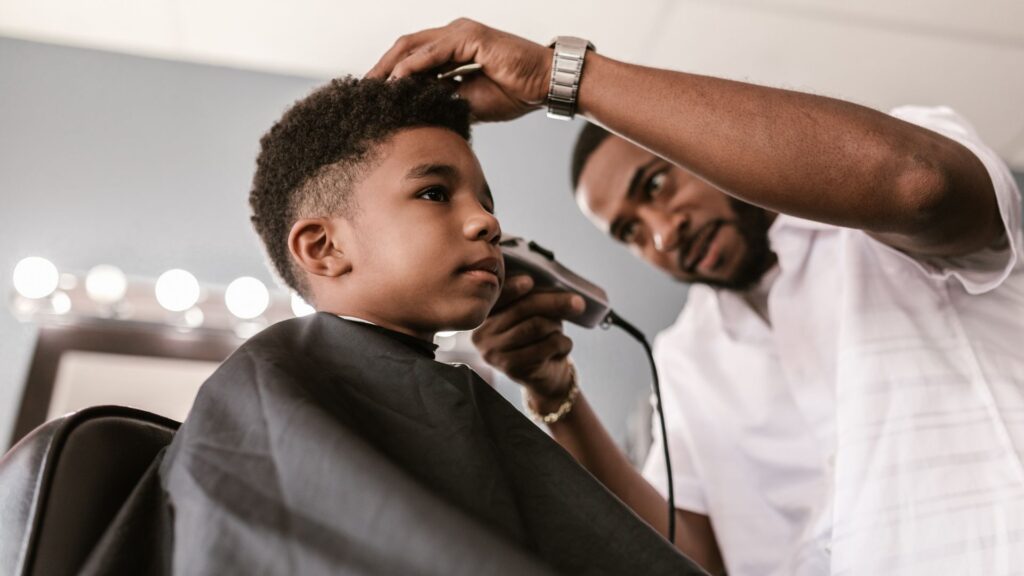
A teenager in the chair is a different animal. He’s quiet, focused, and watching every move in the mirror. His cut isn’t just grooming anymore. It’s identity. It tells his friends, his crush, and his team who he is.
I treat teens like adult clients, because that’s what they want. I ask them what they want, I give them honest feedback, and I don’t talk down to them. If a style won’t work with their hair or head shape, I tell them straight, and I explain why.
There’s something about sitting under the Barbershop Lights at fifteen, getting your first real skin fade, and walking out feeling like a new man. I’ve watched shy kids walk out of the shop standing two inches taller. Never underestimate what a sharp cut does for a teenager’s confidence.
Precision Techniques: Razors, Detail Work, and Texture
With teens, the full toolkit comes out:
- Skin fades using foil shavers and zero-gap trimmers
- Straight razor line-ups for crisp edges, on teens whose skin can handle it
- Hard parts carved in with a trimmer
- Texturizing shears and point cutting to remove bulk from thick tops
- Hot towels at the end to calm the skin and open pores
The razor needs care. If a teen has active acne along the hairline, I skip the razor in that area. Shaving over breakouts can cause irritation and spread bacteria. A trimmer gets close enough without the risk.
Teens also start growing facial hair. Many get their first beard trim or mustache cleanup in the chair. That’s a big moment, sometimes bigger than the first cut. Dads love being there for it.
Teen Trend Cuts and the Classic vs. Trendy Question
Here’s what teens are asking for right now.
| Trend Style | What It Is | Best Hair Type | Maintenance Level |
| Textured crop | Short fringe, messy top, fade sides | Straight or wavy | Medium |
| Burst fade | Fade curving around the ear | Curly, coily, or straight | High |
| Modern mullet | Short front and sides, length in back | Wavy or curly | Medium |
| Taper with twists | Twists on top, tapered sides | Coily hair | High |
| Fringe with drop fade | Forward fringe, fade dropping behind ear | Straight hair | Medium |
| Waves with taper | 360 waves, low taper | Coily hair | High (brushing daily) |
Classic vs. trendy is the real question for many families. A classic cut, like a side part with a taper, ages well. It works for job interviews, weddings, and graduation photos. A trend cut makes a teen feel current but may look dated in two years.
My advice to dads: let teens experiment. Hair grows back. The teenage years are the cheapest time in life to make a style mistake. Just schedule the trendy cuts away from senior pictures.
Different ages call for different tools, and it helps to see them side by side.
The Barber’s Toolkit: How Tools Change With Age
Tools by Age at a Glance
Here’s what a barber typically reaches for at each stage.
| Tool | Toddlers (1 to 3) | Kids (4 to 7) | Preteens (8 to 12) | Teens (13 to 18) |
| Blunt-tip shears | Primary tool | Common | Occasional | Rare |
| Standard shears | Careful use | Primary for tops | Common | Common |
| Quiet cordless trimmer | Neck only | Edges | Line-ups | Detail work |
| Full clippers with guards | Rarely | Sides and back | Fades and tapers | Fades, skin fades |
| Foil shaver | Never | Never | Rarely | Skin fades |
| Straight razor | Never | Never | Never | Line-ups, if skin allows |
| Hot towel | Never | Rarely | Sometimes | Common |
Clipper Guards vs. Scissor-Over-Comb
Two classic ways to cut the sides. Each has its place.
| Factor | Clipper Guards | Scissor-Over-Comb |
| Speed | Fast | Slower |
| Consistency | Very even length | Depends on barber’s skill |
| Noise | Buzzing | Quiet snipping |
| Kid-friendliness | Can scare young kids | Calmer for anxious kids |
| Finish | Uniform, structured | Softer, more natural |
| Best for | Fades, short sides, busy schedules | Longer sides, sensory-sensitive kids |
Good barbers know both. With an anxious six-year-old, I’ll do the whole cut with scissor-over-comb. It takes longer, but nobody cries.
Straight Razors, Hot Towels, and Talc: When They Make Sense
These are the old-school tools that make a barbershop feel like a barbershop. But they’re not for everyone.
The straight razor belongs with teens and adults. Young kids flinch, and even a small flinch near a sharp blade is a risk not worth taking. Most shops start offering razor line-ups somewhere around 13 to 15, depending on maturity and skin.
The hot towel feels great, but small kids can find it too hot or claustrophobic. For teens, it’s a highlight. It softens stubble, soothes skin after a line-up, and makes the visit feel special.
Talc and neck powder keep hair from sticking to skin. For babies and toddlers, I skip loose powder near the face. Pediatric health experts have long advised keeping powders away from infants because the fine particles can be inhaled. A soft neck brush works fine instead.
Tools are only part of the story. Some kids need a completely different approach because of how they experience the world.
Kids With Sensory Needs, Anxiety, and Special Considerations
Recognizing Sensory Overload in the Chair
For some kids, the barbershop is a sensory nightmare. The buzz of clippers, the tickle of falling hair, the tight cape, the bright lights, the noise of other customers. It’s a lot.
The CDC’s most recent surveillance data estimates that about 1 in 31 eight-year-olds in the U.S. has been identified with autism spectrum disorder. Many of those kids have strong sensory sensitivities. Research cited by the STAR Institute suggests around 1 in 20 children experience sensory processing challenges that affect daily life. That means a busy barber sees these kids every single week.
Signs of overload include covering ears, pulling at the cape, sudden crying, rocking, or freezing up completely. These aren’t “bad behavior.” The kid’s nervous system is overwhelmed.
Barber Strategies That Actually Work
| Strategy | How It Helps |
| Pre-visit tour | Kid sees the shop with no pressure |
| Social story or photos | Kid knows exactly what will happen, step by step |
| Noise-canceling headphones | Reduces clipper buzz |
| Weighted lap pad or blanket | Calming pressure |
| Scissors only, no clippers | Removes the scariest sound and vibration |
| Breaks every few minutes | Lets the kid reset |
| Counting down (“10 more snips”) | Gives the kid a clear end point |
| Cutting while the kid stands or sits on the floor | Removes chair-related fear |
I’ve cut kids sitting on the floor, kids standing next to the chair, and once a kid lying on a beanbag watching cartoons. The rules don’t matter. The kid does.
Quiet Hours vs. Regular Hours
More shops are offering sensory-friendly appointments. Here’s how they compare.
| Factor | Quiet or Sensory-Friendly Hours | Regular Hours |
| Noise level | Low, no music, fewer customers | Busy, music, conversation |
| Lighting | Often dimmed | Full brightness |
| Appointment length | Extended, no rush | Standard slot |
| Barber | Usually trained in sensory needs | Whoever’s available |
| Cost | Sometimes slightly higher | Standard price |
| Best for | Anxious or sensory-sensitive kids | Kids comfortable in the shop |
If your child struggles, call ahead and ask. Even shops without official quiet hours will often book you first thing in the morning before the crowd arrives.
Sensory needs aren’t the only special factor. Hair type and scalp health change the job too.
Hair Types, Textures, and Scalp Health at Every Age
Straight and Wavy Hair Through the Years
Straight hair is the most forgiving to cut but the least forgiving to mistakes. Every line shows. A choppy scissor mark on a straight-haired kid stands out like a scuff on a new pair of sneakers.
For straight and wavy hair, barbers rely heavily on point cutting and texturizing to soften lines on top. Waves can be tricky because they shrink up when dry. A good barber cuts wavy hair a bit longer than the final goal and checks it dry before finishing.
As boys hit puberty, many straight-haired kids notice their hair turning oilier. That means it lies flatter and looks greasy faster. Shorter styles and matte products help.
Curly and Coily Hair: Care and Technique
Curly and coily hair needs a different approach. These textures are more fragile at the bends of each strand. The American Academy of Dermatology notes that tightly coiled hair is more prone to breakage and dryness, so gentle handling matters.
| Hair Type | Cutting Approach | Key Care Tip |
| Loose curls | Cut dry or damp, account for shrinkage | Leave-in conditioner |
| Tight curls | Cut dry to see true shape | Avoid harsh sulfate shampoos |
| Coily | Clippers with guards, shape with comb and pick | Moisturize daily |
| Coily with waves | Low taper, brush-trained | Durag at night, daily brushing |
Barbers who cut coily hair know the line-up is everything. A clean edge on a kid with coily hair makes the whole cut pop. For young kids, I use a trimmer with a gentle touch. Teens get the razor if their skin allows.
A shop that welcomes every texture is a shop worth keeping. If your barber hesitates with your son’s curls, find one who doesn’t.
Common Scalp Issues by Age
Barbers aren’t doctors, but we see a lot of scalps. Here’s what shows up at different ages.
| Condition | Typical Age | What It Looks Like | Barber’s Response |
| Cradle cap | Infants | Yellowish, flaky scales | Gentle cut, skip scrubbing, suggest a pediatrician visit |
| Head lice | 3 to 11 years | Nits near the scalp, itching | Stop service, reschedule after treatment |
| Ringworm (tinea capitis) | School age | Round, scaly bald patches | Stop service, recommend a doctor |
| Dandruff | Preteens and teens | White flakes | Suggest medicated shampoo |
| Acne along the hairline | Teens | Bumps on forehead and temples | Skip the razor, use a trimmer |
The American Academy of Pediatrics notes cradle cap is common in infants and usually clears up within the first year. The CDC estimates 6 to 12 million head lice infestations occur each year in the U.S. among children ages 3 to 11. If a barber spots lice, he’ll stop the service. That’s not judgment. It’s protecting the next kid in the chair.
Even with the right tools and the right knowledge, things go wrong. Here are the mistakes I see most often.
Common Mistakes Parents and Barbers Make
Mistakes Parents Make Before the Visit
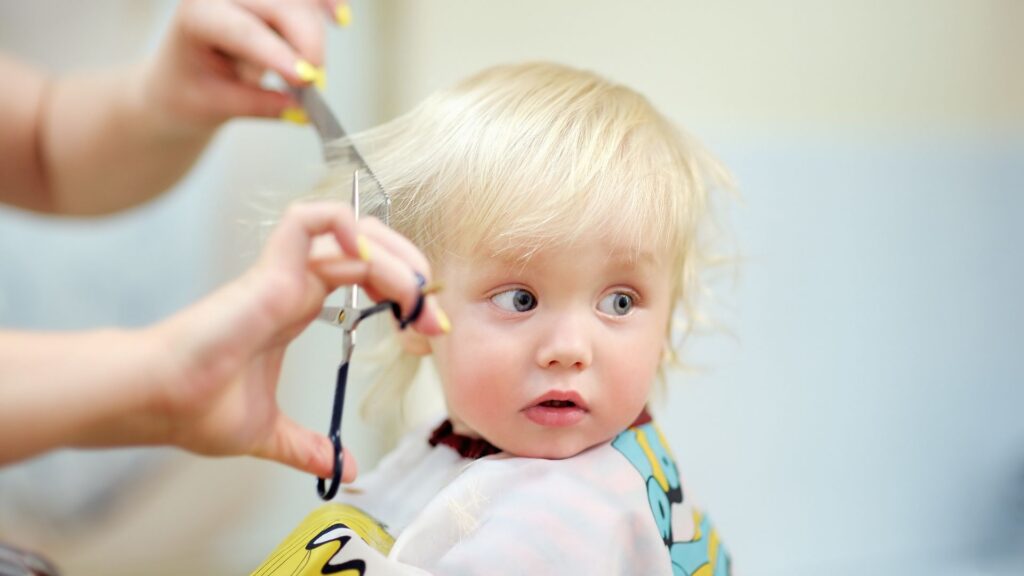
I love dads. But dads make some classic mistakes.
- Hyping it up too much. “This is going to be SO fun!” can make kids suspicious. Keep it casual.
- Using it as a threat. “If you don’t behave, you’re getting your hair cut!” Now the chair is punishment.
- Booking during nap time. We covered this. It’s still the number one mistake.
- Not bringing a photo. “Just a little off the top” means something different to everyone.
- Avoiding the shop altogether. Skipping the barber because a kid is scared usually makes the fear worse, not better.
Mistakes in the Chair
Barbers make mistakes too, especially those who don’t cut a lot of kids.
- Going too short too fast. You can always take more off. You can’t put it back.
- Ignoring the cowlick. Cutting against a growth pattern leaves spikes and holes.
- Rushing a nervous kid. Speed matters, but rushing causes flinching, and flinching causes nicks.
- Skin fades on very young kids. Their scalps are sensitive, and razor bumps are common.
- Talking only to the parent. Kids want to be included. Talk to them.
Fixing a Bad Home Trim
Every barber has seen it. A dad walks in, hat pulled low over his son’s head, and says, “So… I tried it myself.”
| Home Mistake | What Happened | How a Barber Fixes It |
| Bald patch on the side | Clipper guard slipped off | Blend the area with a short fade |
| Crooked bangs | Cut while kid was moving | Shorten and texture the fringe |
| Uneven back | Couldn’t see the angle | Re-taper the nape cleanly |
| Gouge at the crown | Cut against the swirl | Leave length, blend, wait two weeks |
| Choppy top | Used kitchen scissors | Point cut to soften lines |
No shame here. I’ve fixed hundreds. Just don’t make the kid wear a hat for two weeks out of embarrassment. Bring him in.
Theory is one thing. Here’s how all of this plays out with real kids in real chairs.
Real Scenarios From the Chair
The Screaming Two-Year-Old
A mom brought in her son, Marcus, for his first trim. He took one look at the clippers and let out a scream that rattled the mirrors.
I put the clippers away. I handed him a plastic comb and said, “Can you help me comb your daddy’s hair?” His dad, bless him, sat in the chair and let Marcus comb his hair for five minutes. Then I snipped a little piece of Dad’s hair with scissors while Marcus watched.
Then I said, “Your turn?” He nodded. We did the whole cut with scissors in under ten minutes, with Marcus sitting on Dad’s lap. That kid is nine now and still asks for me by name.
Lesson: Show before you do. Kids copy what they see.
The Kid Who Wanted His Favorite Athlete’s Cut
Eleven-year-old Jayden came in with a photo of an NBA star’s high-top fade with a part carved in. His dad gave me the look. You know the look.
I asked Jayden, “What’s your favorite part of this?” He pointed to the part. So I gave him a low fade with a hard part on the side. He got the detail he loved. Dad got a cut that wouldn’t get a note from the principal. Both walked out happy.
Lesson: Find the one detail the kid cares about and build around it.
The Teen and the Picture Day Deadline
Sixteen-year-old Ethan walked in the morning of senior portraits asking for a skin fade, a beard line-up, and “something different on top.” First time ever getting a razor line-up.
I talked him out of the experiment. Not because it wouldn’t look good, but because razor line-ups on first-timers can leave red irritation for a day. He got a clean mid fade, a trimmer line-up, and a hot towel. We booked the bold stuff for the week after.
Lesson: Never try something new right before a big event. Plan your experiments.
The Father-and-Son Saturday
Every Saturday at 9 a.m., a dad named Tony and his twin boys come in. Tony goes first. The boys watch, then take their turns. They’ve done this since the twins were three. Now they’re fourteen.
Tony told me once, “I don’t care much about my own cut. I come for this.” He pointed at the boys arguing about whose fade was better. That’s what a barbershop is. It’s not just hair. It’s the hour a father and his sons spend together without screens, sharing a laugh and the smell of aftershave.
Lesson: Make it a ritual. Kids remember rituals forever.
Now let’s talk about money, because every dad wants to know what he’s paying for.
Cost, Value, and Budgeting for Kids’ Cuts
What Drives the Price
The U.S. barbershop industry is big business. Industry estimates put U.S. barbershop revenue at roughly $5.8 billion in 2024. The U.S. Bureau of Labor Statistics also projects steady growth in jobs for barbers, hairstylists, and cosmetologists this decade. More barbers, more shops, more choices for families.
Prices vary a lot. Here’s what affects them.
| Pricing Factor | How It Affects Cost |
| Location | Big cities cost more than small towns |
| Shop type | Classic neighborhood shop vs. upscale grooming lounge |
| Barber experience | Master barbers often charge more |
| Style complexity | Skin fades and designs cost more than a basic trim |
| Add-ons | Razor line-up, hot towel, beard trim, design work |
| Sensory or extended appointment | Extra time may add cost |
| Day and time | Some shops charge less on weekdays |
Kids’ Pricing vs. Adult Pricing
Most shops have a kids’ price. Here’s how they compare.
| Factor | Kids’ Pricing | Adult Pricing |
| Typical range | $15 to $30 | $25 to $50+ |
| Age cutoff | Usually under 10 or 12 | 12 or 13 and up |
| Services included | Basic cut, simple fade | Full fade, line-up, styling |
| Time in chair | 15 to 25 minutes | 30 to 45 minutes |
| Add-on options | Limited | Full menu |
Once a kid wants a skin fade with a razor line-up, most shops charge the adult rate. That’s fair. The work takes just as long.
Frequency, Memberships, and Tipping
How often your son needs a cut depends on his style and age.
| Age and Style | Typical Frequency | Estimated Yearly Visits |
| Toddler trim | Every 6 to 8 weeks | 6 to 8 |
| Young kid, classic cut | Every 4 to 6 weeks | 8 to 12 |
| Preteen with low fade | Every 3 to 4 weeks | 12 to 16 |
| Teen with skin fade | Every 2 to 3 weeks | 17 to 26 |
That adds up fast with a teen. Many shops now offer monthly memberships that cover unlimited or set visits. If your son gets a fade every two weeks, a membership often saves real money.
On tipping, etiquette experts like the Emily Post Institute suggest 15 to 20 percent for personal services. If your barber handled a meltdown like a champ, tip a little extra. He earned it.
If you’re searching for a haircut near me, compare more than just price. Look for reviews from other parents, ask whether the shop welcomes kids, and see if they offer quiet hours.
Beyond cost, it helps to know where the trade is heading and what products your son actually needs at home.
Expert Insights, Products, and Trends
What’s Trending in Boys’ Cuts Right Now
The biggest shift I’ve seen in recent years is how much social media drives requests. Kids as young as eight walk in with screenshots. Here’s what I’m seeing a lot of in 2026:
- Textured crops with low fades for straight and wavy hair
- Burst fades on all hair types
- Twists and sponge curls with tapers for coily hair
- Modern mullets, still hanging on with teens
- Natural, longer flow for boys who play hockey or lacrosse
Another trend I love: more dads and sons getting matching cuts. Not identical, but the same family of style. Dad gets a classic taper, son gets a playful version of it. It’s a bonding thing.
Home Products by Age and What’s Inside Them
Kids don’t need much product. Teens need a little. Here’s a quick guide.
| Age | Recommended Product | Key Ingredients to Look For | Ingredients to Avoid |
| Toddlers | Tear-free shampoo | Mild cleansers, glycerin | Strong fragrances, harsh sulfates |
| Young kids | Gentle shampoo, light leave-in for curls | Aloe, shea butter, coconut oil | Alcohol-heavy styling sprays |
| Preteens | Light styling cream | Water-based formulas, panthenol | Heavy waxes that clog pores |
| Teens | Clay, paste, or pomade | Kaolin clay, beeswax, natural oils | Heavy petroleum near acne-prone hairline |
| Coily hair, all ages | Moisturizer, curl cream | Shea butter, jojoba oil, glycerin | Drying sulfates, high-alcohol gels |
Gel vs. Pomade vs. Clay for Teens
Teens always ask which product to use. Here’s the honest breakdown.
| Factor | Gel | Pomade | Clay |
| Hold | Strong | Medium to strong | Medium |
| Finish | Wet, shiny | Shiny or semi-shiny | Matte, natural |
| Best for | Spiky or slicked looks | Side parts, pompadours | Textured crops, messy styles |
| Washes out | Easily | Water-based: easily, oil-based: harder | Easily |
| Good for oily scalps | Okay | Can feel heavy | Best choice |
| My pick for most teens | Rarely | For classic styles | Yes |
For most teens with oily, puberty-fueled hair, I recommend a matte clay. It absorbs a bit of oil, gives texture, and doesn’t look greasy by fourth period.
You’ve got the knowledge. Now let’s answer the questions dads ask me most often.
Frequently Asked Questions
How old should my son be for his first trip to the barber?
Most boys come in between 12 months and 2 years old, but there’s no hard rule. Wait until he can sit up steadily and his hair is causing a real problem, like falling into his eyes or growing unevenly. If he’s bald until 18 months, that’s perfectly fine. The right time is when his hair needs it and he can handle a few minutes in the chair.
Should I use scissors or clippers on a toddler?
Scissors are usually best. Toddler hair is fine and soft, and it doesn’t feed evenly through clipper blades. The buzz and vibration of clippers also scare a lot of little kids. A good barber might use a small quiet trimmer to tidy the neck, but the main shaping is done with blunt-tip shears.
My son is terrified of the barbershop. What should I do?
Start small. Visit the shop without a cut so he can see it, meet the barber, and ride the chair up and down. Let him watch you get your own cut first. Bring a favorite toy or tablet. Ask about quiet hours. And never use the barber as a threat. Avoiding the shop entirely tends to make the fear worse, so slow, positive exposure works best.
At what age can kids get a skin fade or razor line-up?
Most barbers hold off on skin fades until around age 10 or older, and razor line-ups until the early to mid teens. Young skin is more sensitive and prone to irritation and razor bumps. Teens with acne along the hairline should skip the razor in that area until the skin clears.
How often should my son get his hair cut?
It depends on the style. Toddlers can go 6 to 8 weeks. Young kids with classic cuts usually need a visit every 4 to 6 weeks. Preteens with fades come in every 3 to 4 weeks. Teens with skin fades often come every 2 to 3 weeks to keep it sharp.
Is it worth buying a barbershop gift card for a teenage boy?
Absolutely. For a teen, a good cut is a confidence boost. A gift card or prepaid membership lets him get a fresh fade before prom, a game, or a first day of school without asking his parents. Pair it with a quality styling clay and you’ve got a gift he’ll actually use.
What should I do if the barber cuts it too short?
Stay calm, especially in front of your son. Hair grows about half an inch a month, so most “too short” situations fix themselves in two to three weeks. Talk to the barber privately about what went wrong. A good barber will listen and adjust next time. Next visit, bring a photo and specify the guard number you want.
Do kids with curly or coily hair need a special barber?
They need a barber experienced with their texture. Curly and coily hair is cut differently, often dry, with careful attention to shrinkage and line-ups. Ask the shop directly whether their barbers regularly cut your son’s hair type. A welcoming shop will say yes without hesitation and show you examples.
With your questions answered, here’s a simple plan to put everything into action.
Your Action Plan for Every Stage
Before-the-Appointment Checklist
Run through this before every visit:
- Book after a nap and a snack (for younger kids)
- Choose a weekday morning if possible
- Bring a photo of the style you want
- Pack a comfort item or tablet for toddlers
- Ask for a kid-friendly or sensory-trained barber if needed
- Check the calendar for big events and plan around them
- Talk to your son about what will happen, calmly and simply
- Bring cash for a tip
Age-by-Age Cheat Sheet
Pin this to the fridge.
| Age | Main Goal | Best Tools | Typical Style | Visit Length |
| 1 to 3 | Comfort and trust | Blunt-tip scissors, quiet trimmer | Simple trim | 10 to 15 min |
| 4 to 7 | Build confidence | Scissors, clippers with guards | Crew, short back and sides | 15 to 20 min |
| 8 to 12 | Include the kid in decisions | Clippers, trimmers | Low fade, taper, line-up | 20 to 30 min |
| 13 to 18 | Precision and identity | Full toolkit, razor, foil shaver | Skin fades, trend cuts | 30 to 45 min |
A Final Word From the Chair
After two decades of cutting kids, here’s what I know for sure. The first cut is never really about the hair. It’s about a little boy learning that a stranger with sharp tools can be kind. It’s about a dad holding his son on his lap under a cape, both of them covered in tiny clippings. It’s about a teenager seeing himself in the mirror and liking what he sees. Techniques change with age. Scissors give way to clippers. Clippers give way to razors. Booster boards give way to full-size chairs. But the heart of it stays the same: patience, trust, and respect for the person in the chair. So book that appointment. Bring the camera. Save the lock of hair. And when your son walks out of the shop years from now with a fresh fade and his chin up, you’ll remember that first wobbly visit and smile.